

Your CAC is climbing and your attribution dashboard is showing you installs — but not which channel produced users who actually convert, retain, or pay. The budget is not the problem. The measurement layer is. Most campaign optimisation frameworks were built for web funnels where a click maps cleanly to a conversion. Mobile apps break that model at every stage: app store redirects, deferred deep links, SKAdNetwork signal loss, and post-install behaviour that unfolds across days or weeks.
In 2025, this gap is more costly than ever. Platforms like Google and Apple have shifted toward value-based bidding and AI-driven CPA optimisation (Source: Campaign ME, 2025), meaning the quality of your first-party attribution data directly determines how well your automated bidding performs. Feed weak signals in, get wasteful spend out.
This guide covers attribution infrastructure, platform-specific campaign optimisation tactics for Apple Search Ads, Google UAC, and TikTok, LTV-driven budget allocation, and the mistakes that keep CAC high regardless of how much you spend.
---
What Is Campaign Optimisation and What Are the Two Types?
Campaign optimisation in mobile app marketing has two distinct types: pre-launch optimisation, which covers configuring targeting parameters, creative variants, and measurement infrastructure before spend goes live; and post-launch optimisation, which involves iterating on bids, audiences, and creatives based on real performance data. Both types operate on different inputs and timelines — conflating them is one of the most common causes of wasted early spend on mobile campaigns.
Pre-Launch Optimisation: Signals, Targeting, and Creative Setup
Pre-launch optimisation is the work that determines how much signal your campaigns generate from day one. This means choosing the right campaign objective (installs versus in-app events), setting up conversion events in your MMP before launch, and structuring creative variants to produce statistically meaningful test results.
Skipping this phase — or treating it as a checklist — means your post-launch campaign optimizations are built on a shaky foundation. Algorithmic bidding systems need clean event data from the first spend, not retrofitted after week two.
Post-Launch Optimisation: Bid Adjustments, Event Weighting, and Funnel Pruning
Post-launch optimisation is where most growth marketers spend their time, but it only works when the pre-launch setup is solid. The core activities are adjusting bids based on actual cost-per-event data, reweighting conversion events as you learn which ones predict LTV, and cutting audience segments or creative assets that drain budget without producing retained users.
The decision cadence matters: making bid changes daily based on insufficient data is as damaging as waiting six weeks to act on obvious underperformance.
---
Why Standard Campaign Optimisation Fails Mobile App Marketers
Web-centric optimisation logic fails mobile apps because it assumes a direct, trackable path from ad click to conversion. Mobile apps have no such path — the journey goes through an app store, an OS-level permission prompt, a deep link, and a post-install experience that the ad platform cannot observe unless you explicitly wire it up.
The Attribution Gap Between Install and Revenue
An install is not a conversion. For most mobile apps, the events that predict revenue — registration completion, subscription start, first purchase — happen hours or days after install, and on a device where ad platforms have limited visibility. Without an attribution layer that connects the original ad click to these downstream events, your app marketing digital reporting shows cost per install but not cost per paying user.
This creates a systematic bias: channels that drive cheap installs look efficient, while channels that drive expensive installs with high LTV look wasteful. Budget gets reallocated in exactly the wrong direction.
How iOS 14+ Privacy Changes Disrupted Mobile Measurement
Apple's App Tracking Transparency (ATT) framework, launched with iOS 14.5, removed access to device-level IDFA for apps that do not receive user opt-in — and opt-in rates typically sit below 30% across most app categories. SKAdNetwork, Apple's privacy-preserving attribution API, compensates partially but introduces conversion value windows and reporting delays that make post-install event attribution coarse at best.
The practical result: a significant portion of iOS traffic is attributed to "unknown" or modelled sources, and granular event-level data is unavailable for the majority of users. Any application marketing strategy that ignores this limitation will misread iOS channel performance.
Why Automated Bidding Amplifies Bad Attribution Data
Google UAC, Apple Search Ads automated bidding, and TikTok's event-optimised campaigns all learn from the conversion signals you feed them. If you are passing only install events — or worse, no post-install events — the algorithm optimises for the cheapest installs, not the most valuable users.
Bad attribution data does not just give you wrong reports; it actively trains platform algorithms to find the wrong users. Cleaning up your measurement infrastructure is not a reporting exercise — it is a prerequisite for any campaign optimization to work.
---
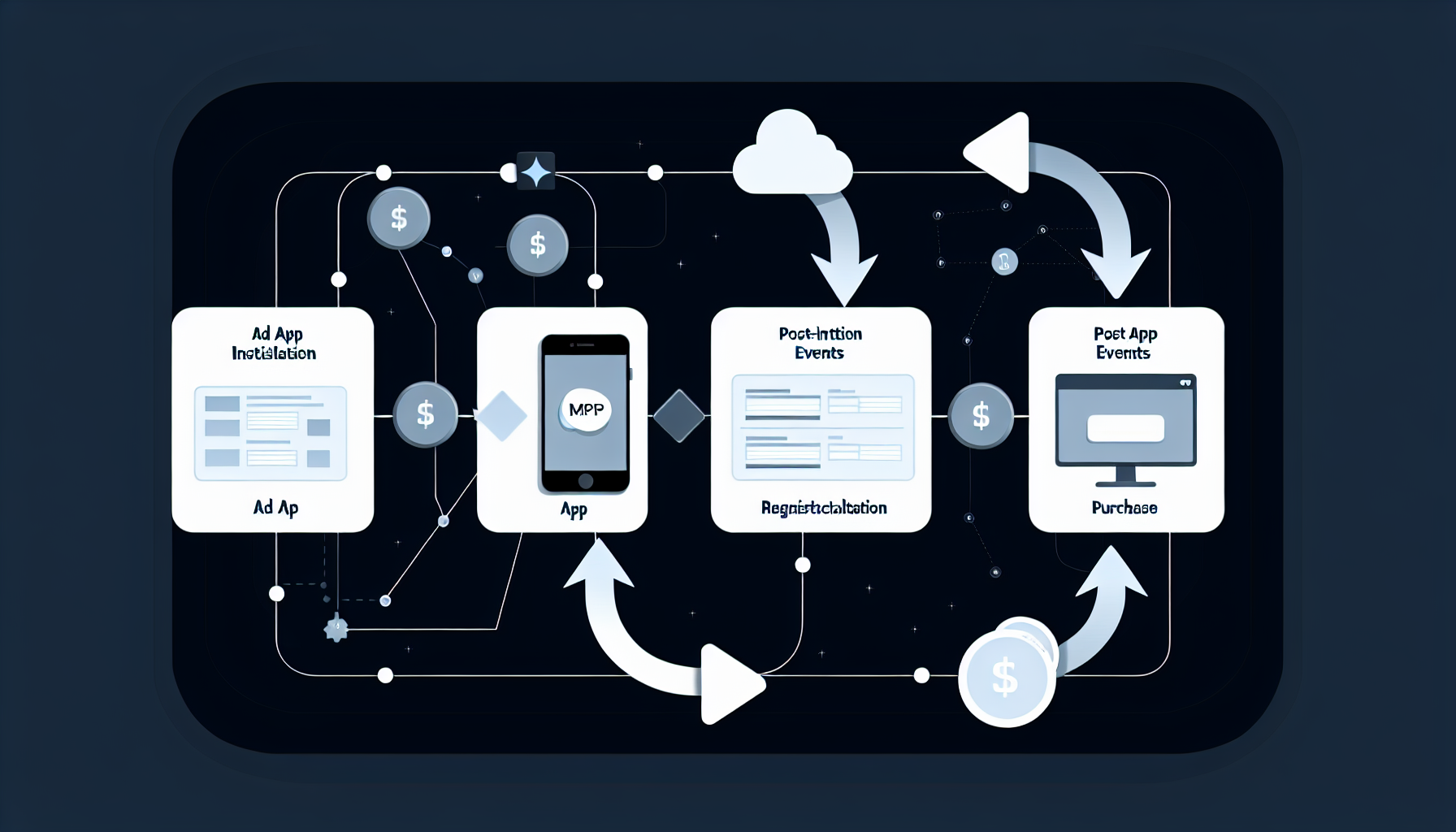
Build the Attribution Foundation Your Campaign Optimisation Depends On
Every platform-specific tactic in this guide depends on one thing: a reliable attribution layer that connects ad spend to post-install behaviour. Without it, you are optimising based on platform-reported metrics that are incomplete, self-serving, or simply wrong.
Which Post-Install Events to Track for Meaningful Optimisation
Track events that signal intent and predict value — not events that are easy to fire. Here are seven post-install events that function as genuine optimisation signals:
- Registration completion — Separates users who engaged from those who opened and abandoned. High registration rates indicate onboarding quality and targeting accuracy.
- Onboarding step completion — If your app has a multi-step onboarding, the drop-off point identifies friction and predicts 7-day retention.
- First purchase or first payment — The clearest revenue signal. Feeds value-based bidding with a direct LTV proxy when passed with a revenue value.
- Subscription start — For subscription apps, this is the primary LTV event. Distinguish between trial starts and paid starts.
- Level completion (games) — Predicts long-term engagement and IAP likelihood. Specific level thresholds (e.g., level 5 or 10) correlate with retained payers in most casual game categories.
- Content unlock or key feature activation — For utility or productivity apps, the moment a user activates the core feature predicts 30-day retention more accurately than session count.
- App referral send — Users who refer others have materially higher LTV and lower churn. Tracking this event also feeds app referral program optimisation and helps identify high-value audience segments.
Deep Linking and Attribution: Why They Must Work Together
Attribution tells you which ad drove a user. Deep linking determines where that user lands inside your app. When they are disconnected, a user clicks an ad for a specific product or feature, lands on a generic home screen, and churns — even though the attribution data records a successful install.
Deep linking is not just a UX improvement; it is an optimisation lever. Users who land on the right in-app destination convert at higher rates, which improves your post-install event signals, which improves your automated bidding performance. For anyone creating an app business or scaling an existing one, treating deep linking and attribution as separate tools is a structural inefficiency.
Setting Up an MMP Without a Six-Week Engineering Sprint
Most growth marketers know they need an MMP. The blocker is implementation. Enterprise MMPs like AppsFlyer, Adjust, and Branch are built for large teams and often require significant engineering time, custom SDK configurations, and ongoing maintenance contracts before a single attribution signal is live.
If your team is at the SMB or mid-market stage, that timeline directly delays your optimisation signals — and every week of delay is a week of automated bidding running without proper training data. Deeplinkly is a privacy-first MMP and deep linking platform built specifically for mobile app teams that need to move fast. Setup takes under 30 minutes, attribution and deep linking are included in a single integration, and pricing is positioned as a direct alternative to the higher-cost enterprise tools — without requiring a second tool for deep links. Faster setup means your optimisation signals start reaching platform algorithms sooner, which compresses the learning phase on Google UAC and Apple Search Ads automated bidding campaigns.
---
Platform-Specific Campaign Optimisation: Apple Search Ads, Google UAC, and TikTok
Each platform has distinct optimisation levers. Applying the same logic across all three is one of the fastest ways to leave performance on the table.
Apple Search Ads: CPT Bidding, Creative Sets, and Search Match Optimisation
The most important distinction in Apple Search Ads campaign optimisation is between Search Match and Exact Match campaigns. Search Match automatically matches your ad to relevant search terms — useful for discovery but expensive for precision. Exact Match gives you control over which terms trigger your ad and produces cleaner attribution data because you know exactly what intent drove the install.
A common mid-level mistake: running Search Match campaigns and interpreting their performance as representative of keyword-level demand. Use Search Match to mine new keyword opportunities, then move confirmed performers into Exact Match campaigns with targeted CPT bids. For creative sets, map your app preview and screenshots to the specific intent of each keyword cluster — generic creative across all ad groups reduces relevance scores and raises CPT.
Do this first: Audit your Search Match search term reports and move your top-five converting terms to dedicated Exact Match campaigns with controlled bids.
Google UAC: Value Bidding, In-App Event Goals, and Asset Group Testing
Google UAC's automation quality depends entirely on the conversion events you assign as campaign goals. Campaigns set to optimise for installs will find the cheapest installs — which are rarely the most valuable users. Shifting your campaign goal to a post-install event (first purchase, subscription start) with a target return on ad spend immediately re-trains the algorithm toward revenue-generating behaviour.
In 2025, value-based bidding in UAC — where you pass revenue values alongside conversion events — is driving measurably better LTV outcomes for app campaigns as Google's AI models become more capable of predicting user quality (Source: Campaign ME, 2025). Pass revenue values for each purchase event rather than a flat conversion signal. Asset group testing should run with a minimum of three to five creative variants per group, with at least two weeks of data before pruning underperformers.
Do this first: Change your UAC campaign goal from installs to your highest-value post-install event, and confirm your MMP is passing revenue values to Google.
TikTok for App Installs: Creative Fatigue Cycles and Event Optimisation Windows
TikTok's app install campaigns degrade faster than other platforms because creative fatigue sets in quickly with a high-frequency audience. The optimisation lever most teams miss is refresh cadence — not just creative quality. Even high-performing creatives on TikTok typically see significant CPM and CPA degradation within seven to fourteen days.
Structure your creative pipeline to introduce new variants weekly, not monthly. For event optimisation, TikTok's algorithm needs a minimum volume of optimisation events — typically 50 per week per ad group — before it exits the learning phase. Setting event goals that are too deep in the funnel (e.g., subscription start on a new campaign) will stall learning. Start with registration or onboarding completion, then shift the goal downstream as volume builds.
Do this first: Check the event volume on your TikTok optimisation goal. If it is below 50 per week, move to a higher-funnel event to exit the learning phase faster.
---
LTV-Driven Campaign Optimisation: Moving Beyond Cost Per Install
CPI is a channel comparison metric. It is not an optimisation target. Two channels at the same CPI can have a 3x difference in 90-day LTV — and if your campaign optimisation logic is built around CPI, you will systematically defund the better channel.
How to Define LTV Cohorts for Bid Optimisation
A useful LTV cohort groups users by acquisition source, campaign, and timeframe, then tracks their revenue contribution at 7, 30, and 90 days post-install. The point is not to calculate an exact LTV number — it is to establish relative value rankings across channels so you can adjust bids accordingly.
A concrete example: users acquired through Apple Search Ads Exact Match on branded terms frequently show LTV three times higher than users from broad discovery campaigns at the same CPI. At face value, both look equally efficient. At the cohort level, the branded Exact Match campaign justifies a significantly higher CPT bid — and budget reallocation from the broad campaign is the correct decision, not the intuitive one.
Using Predictive LTV Signals in Automated Bidding Campaigns
Most apps cannot wait 90 days to evaluate LTV before making bid decisions. Predictive LTV uses early behavioural signals — session depth, feature activation, onboarding completion rate — to estimate a user's likely long-term value within the first 24 to 72 hours post-install.
Passing these predictive signals as weighted conversion values to UAC or Apple Search Ads means the algorithm is trained on expected LTV rather than binary install events. Even a rough 3-tier value model (low, medium, high value user signals) materially improves bid quality compared to flat conversion values.
CAC Benchmarking by Channel and User Segment
The 3:1 LTV:CAC ratio commonly used in SaaS is a reasonable starting point, but mobile apps often need to adjust this threshold based on payback period and category. A gaming app with high D7 monetisation can tolerate a tighter payback window than a subscription fitness app where payback occurs over months.
Define your target LTV:CAC ratio per channel and segment, then use it as a bidding constraint rather than an aspirational metric. If a channel's CAC consistently exceeds your target by 20% or more across two consecutive measurement periods, it is a structural problem — not a creative problem — and reducing bids or pausing the channel is the correct action.
---
Budget Allocation and Campaign Optimisation Across Channels
Budget decisions made on gut feel or platform rep recommendations systematically overfund underperforming channels. A structured allocation model forces those decisions onto data.
The 70/20/10 Allocation Model for Mobile App Acquisition
Allocate 70% of your acquisition budget to channels with a proven positive LTV:CAC ratio — these are your core app user acquisition channels where you are scaling what works. Allocate 20% to channels in a structured testing phase: these have defined experiment parameters, a minimum run period, and a clear success metric before any further investment. Allocate 10% to exploratory channels — new platforms, formats, or audience segments — with no expectation of immediate return but a defined evaluation timeline.
This model only works if you maintain the discipline not to raid the 10% bucket to prop up a struggling core channel.
When to Scale a Campaign Versus When to Cut It
Scale when: LTV:CAC is at or above your target ratio for two consecutive weeks, volume has room to grow without cannibalising other segments, and the campaign has exited the algorithmic learning phase.
Cut or pause when: CAC exceeds your target by more than 20% for two consecutive weeks, or when 30-day retention for the cohort falls below your category benchmark — not just when installs slow down. Slow installs on a high-LTV channel is a bidding problem. Low retention is a targeting or creative problem, and more budget will not fix it.
Cross-Channel Attribution and Budget Decisions
Single-touch last-click attribution will consistently over-credit the final touchpoint before install — often a retargeting or brand campaign — and under-credit earlier channels that drove awareness and intent. Budget decisions based on last-click data defund top-of-funnel channels that are doing real work.
Use data-driven or position-based attribution models in your MMP to distribute credit across touchpoints. This is particularly important when creating an app business from a small user base: early-stage misattribution can permanently skew which channels you invest in during your highest-growth window.
---
Common Campaign Optimisation Mistakes That Inflate Mobile CAC
Optimising for Installs When You Should Optimise for Events
Setting install as your campaign optimisation goal is the single most common driver of high CAC in mobile app acquisition. It trains platform algorithms to find users who tap "get" — not users who register, pay, or retain. The CAC you report looks low because CPI looks low, but the actual cost per retained user or per paying user is 3 to 5 times higher.
Switch your campaign goal to the earliest post-install event that has sufficient volume — typically registration completion or onboarding step three. Once you have enough data, push the goal further down the funnel toward revenue events.
Ignoring Mobile Landing Page and App Store Page Performance
Your paid media optimisation stops at the click if your mobile landing page or App Store listing loses the user before the install. Slow load times on mobile landing pages drive abandonment rates that make even well-targeted campaigns look inefficient — and every abandoned visit is wasted CAC spend (Source: Essential Marketer). Fast load times and clear, specific CTAs are the two highest-impact improvements on mobile pre-install pages (Source: Venture Harbour).
Treat your App Store page as a conversion rate optimisation asset, not a static listing. A 1% improvement in App Store conversion rate reduces your effective CAC without touching your bids.
Cutting Campaigns Before the Algorithmic Learning Phase Ends
Google UAC, Apple Search Ads, and TikTok all require a minimum data volume before their algorithms exit the learning phase and begin optimising efficiently. Cutting or significantly modifying a campaign in the first seven to fourteen days — when CPA typically looks worst — resets the learning phase and wastes the accumulated signal.
Define a minimum learning period for each platform before making structural campaign changes. Minor creative additions are acceptable. Changing the optimisation event, bid strategy, or audience targeting resets learning entirely.
---
Frequently Asked Questions
What is campaign optimisation in mobile app marketing?
Campaign optimisation in mobile app marketing is the process of improving paid acquisition campaigns to reduce CAC and increase user quality. It operates in two phases: pre-launch setup of targeting, creative, and measurement infrastructure, and post-launch iteration on bids, audiences, and conversion events based on real performance data.
How do I lower CAC for my mobile app acquisition campaigns?
Lower CAC by shifting your campaign optimisation goal from installs to post-install events that predict revenue, improving your App Store conversion rate to reduce wasted ad spend, and reallocating budget toward channels with the highest LTV:CAC ratio rather than the lowest CPI.
What is the difference between campaign optimisation on iOS versus Android?
iOS optimisation is constrained by ATT opt-out rates and SKAdNetwork's limited event windows, requiring more reliance on modelled attribution and aggregated signals. Android retains more granular device-level attribution, allowing for richer post-install event tracking and faster algorithm learning on Google UAC.
How does an MMP help with campaign optimisation?
An MMP attributes installs and post-install events to their source campaigns, passes conversion signals back to ad platforms, and provides a single source of truth across channels. Without an MMP, platform-reported attribution is siloed, often self-serving, and cannot connect install sources to downstream revenue behaviour.
What post-install events should I track for campaign optimisation?
Track events that predict revenue or retention: registration completion, onboarding step completion, first purchase, subscription start, key feature activation, level completion (for games), and app referral sends. Avoid tracking events that are high-volume but structurally uncorrelated with LTV, such as session start or notification permission grants.
How long should I run a mobile campaign before optimising?
Run a campaign for a minimum of seven to fourteen days before making structural changes, depending on the platform. Google UAC and TikTok require at least 50 optimisation events per week to exit the learning phase. Making bid strategy or event goal changes before that threshold resets algorithmic learning and increases early-phase CAC.
---
Conclusion
The framework in this guide is actionable — but only if your attribution layer is working. The most common reason campaign optimisation stalls is not a lack of tactics; it is that the measurement infrastructure is missing, incomplete, or built for web funnels that do not map to mobile app behaviour. Without clean attribution, you are reallocating budget based on platform-reported numbers that do not reflect actual user value, and your automated bidding campaigns are learning from signals that actively point them toward the wrong users.
Every week of operating without a proper MMP is a week of compounding waste: spend going to underperforming channels, algorithms trained on low-quality conversion signals, and CAC that does not respond to bid or creative changes because the underlying data is wrong.
When attribution is clean, the trajectory changes. Algorithms learn faster, budget reallocations are based on actual LTV data, and value-based bidding compounds over time as platforms accumulate richer signals about your highest-value users.
See how Deeplinkly connects attribution and deep linking in one setup — with implementation in under 30 minutes.
Start with clean attribution — everything else follows
The most common reason campaign optimisation stalls is not a lack of tactics; it is that the measurement layer is broken. Deeplinkly connects attribution and deep linking in one setup, with implementation in under 30 minutes. Start free or talk to sales.