

You're scaling spend across Meta, Google UAC, and TikTok — and every channel is claiming credit for the same install. Your CAC looks inflated, ROAS signals conflict across dashboards, and budget decisions get made based on whoever reported the conversion first. This is the core attribution problem in mobile growth, and it costs teams real money every day.
Attribution modeling is the technical framework that determines which ad touchpoints get credit for a conversion. In 2025, playbooks are shifting hard toward multi-touch and data-driven models as single-source reporting consistently misleads spend decisions (Source: HockeyStack, 2025). Getting this right isn't a reporting preference — it's the operational backbone of any profitable mobile user acquisition strategy.
---
What Is Attribution Modeling and Why Does It Matter for Mobile Apps
Attribution Modeling Defined
Attribution modeling is the method by which credit for a conversion — an install, purchase, or in-app event — is assigned across the marketing touchpoints that preceded it. In mobile apps, this means connecting an ad click or impression to an app install and downstream revenue events. The model you choose determines how much credit each channel receives and, consequently, where you allocate budget.
Mobile attribution adds layers of complexity that web attribution doesn't face: app store intermediaries, device identifiers governed by privacy frameworks, and install flows that break traditional cookie-based tracking entirely.
Why Mobile Attribution Is Different From Web
On the web, a pixel fires, a cookie drops, and a session is tracked. In mobile apps, the install happens inside an app store — a black box that sits between your ad click and the user opening your app for the first time.
There's no persistent cookie. Identity is tied to device identifiers like IDFA (iOS) or GAID (Android), both of which are increasingly restricted. The attribution chain has to be reconstructed by a mobile measurement partner using a combination of click timestamps, device signals, and cryptographic matching.
The Cost of Getting It Wrong
Over-relying on last-click attribution is one of the most common and costly mistakes in mobile UA. It consistently overvalues the final touchpoint — often a retargeting ad or branded search — while ignoring the awareness channels that drove the user into the funnel (Source: DigGrowth).
In practice, this means Meta or TikTok upper-funnel spend gets cut because it "shows no installs," while retargeting budgets balloon. Revenue stays flat. The model was lying the whole time.
---
The Main Attribution Modeling Types Every Mobile Marketer Should Know
Last-Click Attribution
Last-click gives 100% of conversion credit to the final touchpoint before install. It's simple to implement and easy to report on, which is why it remains the default in many ad platforms.
Mobile use case: viable for apps with short, single-channel consideration cycles — simple utilities or hyper-casual games where users install immediately after seeing one ad. Risk: it systematically undercredits awareness channels and produces misleading CAC figures in multi-channel campaigns.
First-Click Attribution
First-click assigns all credit to the first recorded touchpoint. It tells you which channel introduced the user, which has value for understanding awareness reach.
Mobile use case: useful for measuring top-of-funnel channel effectiveness — which network is best at acquiring net-new users. Risk: it ignores everything that closed the conversion, making it a poor model for spend optimization across a full funnel.
Linear and Time-Decay Models
Linear attribution splits credit equally across all touchpoints within the attribution window. Time-decay assigns more credit to touchpoints closer to the conversion event.
Mobile use case: linear works well for apps with longer consideration cycles like fintech or health apps where multiple touchpoints are genuinely influential. Time-decay suits campaigns where late-stage retargeting legitimately drives conversion decisions. Attribution windows matter critically here — touchpoints outside the window receive zero credit regardless of their actual influence.
Position-Based (U-Shaped) Attribution
Position-based models assign fixed weights to the first and last touchpoints — typically 40% each — with the remaining 20% distributed across middle interactions.
Mobile use case: strong for subscription apps or high-LTV categories where both acquisition source and final conversion channel carry strategic importance. Risk: the fixed weighting is arbitrary and doesn't reflect actual user behavior.
Data-Driven Attribution
Data-driven attribution uses machine learning to assign credit based on the actual conversion contribution of each touchpoint, derived from your historical campaign data.
Mobile use case: best-in-class for mature apps with sufficient conversion volume and multi-channel UA. It removes the guesswork from weighting decisions entirely. Expert analysis consistently shows that attribution strategies must integrate multi-touch data with real-time agility to remain effective in today's mobile environment (Source: ZigPoll). Risk: requires significant data volume — low-install-volume apps won't have enough signal to train reliable models.
Attribution Model Comparison
| Model | Touchpoints Credited | Best For | Risk |
|---|---|---|---|
| Last-Click | Final touchpoint only | Short-cycle apps, single channel | Undervalues awareness spend |
| First-Click | First touchpoint only | Top-of-funnel analysis | Ignores conversion drivers |
| Linear | All equally | Multi-channel, long consideration | Over-simplifies contribution |
| Time-Decay | All, weighted toward close | Retargeting-heavy funnels | Undervalues discovery channels |
| Position-Based | First + last, with middle | High-LTV subscription apps | Arbitrary weight assignment |
| Data-Driven | All, weighted by ML model | Mature apps, high volume | Requires data scale to function |
---
How Attribution Modeling Works Inside a Mobile MMP
How MMPs Collect Install and Event Data
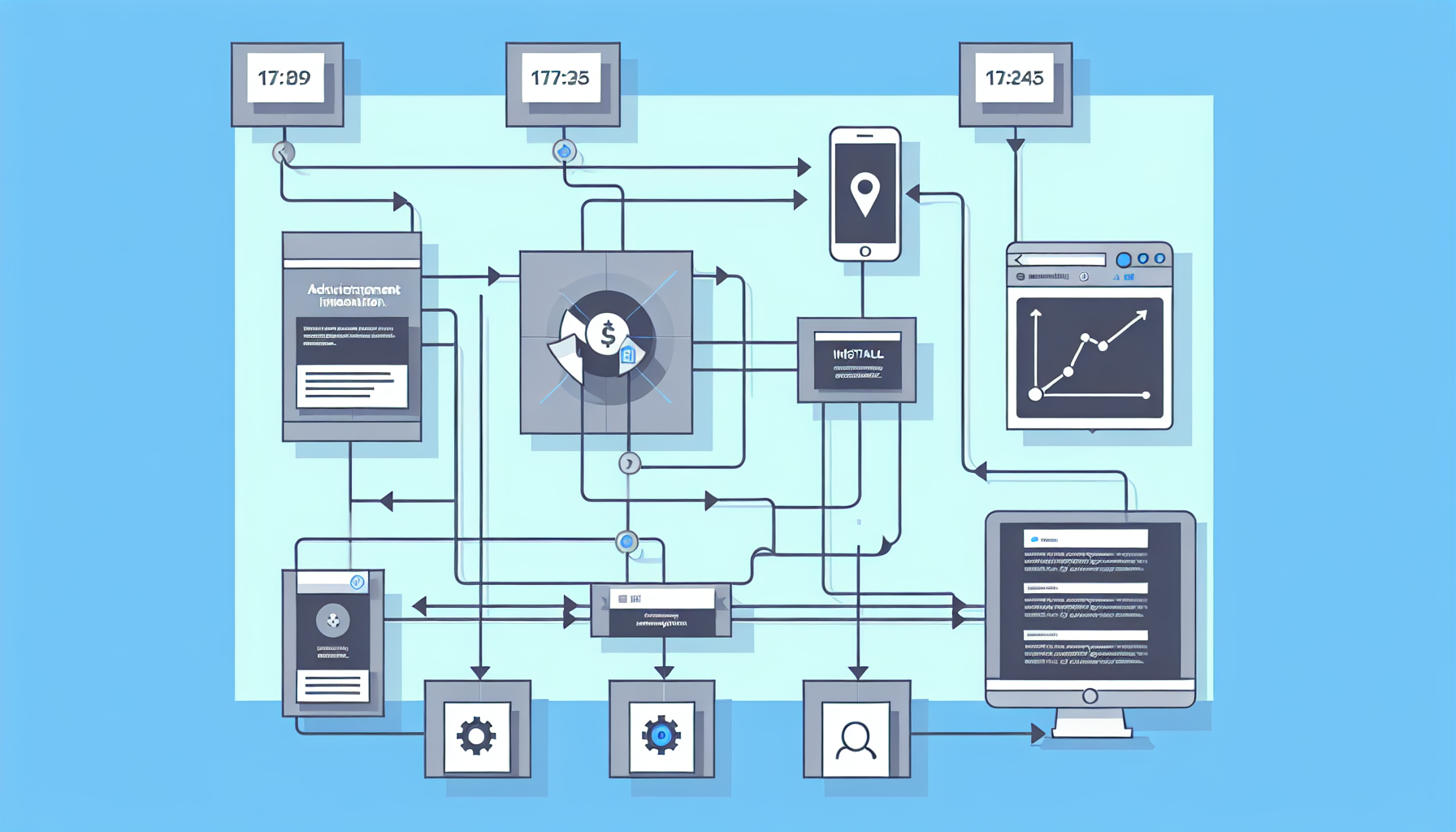
A mobile measurement partner sits between your ad networks and your app. When a user clicks an ad, the MMP records a click with a timestamp and device metadata. When the user installs the app and opens it, the MMP SDK fires — it checks for a matching click record and, if one exists within the attribution window, assigns the install to that ad network.
Every subsequent in-app event — purchase, subscription, level completion — is also sent to the MMP as a postback. This event data is what populates your ROAS reporting and feeds back into ad network optimization algorithms.
Deterministic vs Probabilistic Attribution
Deterministic attribution matches installs to clicks using a unique identifier. On iOS, this is the IDFA (when the user has granted tracking permission). On Android, it's the GAID or Google Play Install Referrer. When the identifier on the click matches the identifier on the install event, the match is exact — no ambiguity.
Some MMPs offer probabilistic attribution when no deterministic identifier is available. They infer a click-to-install pair from signals such as IP address, device model, OS version, and timing. That result is less precise, is not a deterministic user-level match, and can raise privacy and platform-policy concerns. Deeplinkly does not use this method; unsupported installs remain unattributed.
Setting Your Attribution Window in an MMP
The attribution window defines how long after a click or impression an install can still be credited to that touchpoint. Standard defaults in most MMPs are 7 days for click-through attribution and 1 day for view-through attribution — but these are configurable.
Setting windows incorrectly creates real measurement errors. Too long a click window, and you're crediting installs that had nothing to do with that ad. Too short, and you're stripping credit from legitimate conversions, particularly on slower-consideration categories. Most platforms including the Adjust tool allow you to configure windows per network and per campaign type, which matters when search traffic converts in hours but display traffic converts across days.
If you're evaluating MMP options — or reconsidering tools like Adjust or AppsFlyer due to pricing — Deeplinkly offers deterministic attribution without device fingerprinting, with SDK setup in under 30 minutes. Unlike Adjust pricing or AppsFlyer pricing tiers that scale sharply with event volume, Deeplinkly is built to be affordable from day one, making it a practical option for growing apps that need attribution without enterprise-level cost.
---
iOS Attribution Modeling After ATT: SKAdNetwork and Privacy-First Tracking
What ATT and App Tracking Transparency Changed
Apple's App Tracking Transparency framework, enforced from iOS 14.5 onward, requires apps to request explicit user permission before accessing the IDFA. Opt-in rates settled well below 50% across most categories. For mobile attribution, this removed the primary deterministic identifier from the majority of iOS installs.
The result: a large portion of iOS traffic became unmatchable using traditional deterministic methods. MMPs had to adapt, and so did attribution modeling strategies.
How SKAdNetwork Attribution Works
SKAdNetwork is Apple's privacy-preserving attribution API. Instead of the MMP receiving user-level install data, Apple acts as the intermediary. When a user installs an app after clicking an ad, Apple validates the install and sends a postback directly to the ad network — with a conversion value encoded as an integer (0–63 in SKAdNetwork 3.0, with finer-grained values in version 4.0).
The postback is delayed by a randomized timer. There is no device-level data in the postback. You receive an aggregated signal: this campaign drove X installs with Y conversion value — and nothing more granular than that.
Modeling Conversions Without Device-Level Data
The conversion value is the only signal you control in SKAdNetwork, and mapping it correctly is critical. Marketers typically map conversion values to early revenue events — first purchase, subscription trial start, or a revenue threshold reached within the measurement window — rather than to later LTV signals that occur outside the postback window.
This requires deliberate conversion value schema design before launch. If you map conversion values to events that most users don't reach, you'll receive mostly zero-value postbacks and lose the optimization signal entirely.
Privacy-First Attribution Strategies for iOS
For users who do not grant ATT permission, use Apple's privacy-preserving aggregate attribution mechanisms where applicable and leave unsupported user-level installs unattributed. Do not substitute device fingerprinting for permission.
Aggregate platform reporting can still give iOS campaigns directional data without claiming an inferred device-level match. A privacy-conscious measurement layer should keep aggregate results distinct from deterministic attribution.
---
Android Attribution Modeling and Cross-Device Challenges
Google Play Install Referrer and GAID
Android attribution is significantly more deterministic than iOS. Google Play Install Referrer passes a URL parameter from the ad click through the Play Store install flow directly to the app — no identifier opt-in required. Combined with the Google Advertising ID (GAID), Android attribution achieves high match rates with minimal signal loss.
This makes Android the more reliable measurement environment in 2025. MMPs receive clean click-to-install chains on Android, and attribution windows can be configured with precision because the referrer timestamp is exact.
Cross-Device Attribution in Mobile Campaigns
A user sees a Meta ad on desktop, searches for your app on their phone later that evening, and installs from the App Store. Which touchpoint gets credit? Without cross-device matching, the desktop impression is invisible — the install looks organic, and your paid social channel is undervalued.
Ignoring cross-device journeys is a documented source of attribution error that causes marketers to systematically misread channel performance (Source: DigGrowth). Cross-device attribution requires either probabilistic identity stitching across devices or deterministic matching via logged-in identity graphs — both of which operate within privacy constraints but add complexity to your MMP configuration.
Stitching Web-to-App Journeys
Web-to-app journeys — where a user clicks a mobile web ad and converts inside the app — require deferred deep linking combined with attribution tracking. The attribution window configuration matters significantly here: web-to-app journeys often have longer latency than direct app-to-app clicks because users may browse on web before deciding to install.
Setting a 1-day click window for web sources will miss a meaningful portion of legitimate conversions. A 3-to-7-day window for web-originated traffic is more accurate and should be configured separately from your in-app ad network windows.
---
Choosing the Right Attribution Model for Your Mobile App
Match Your Model to Your App's Conversion Cycle
If your app has a short conversion cycle — casual games, simple utilities, single-session decision categories — last-click attribution may still give you useful signal. The user saw one ad, installed, and the journey was linear.
If your UA runs across three or more channels before a user installs — which is the norm for fintech, health, and subscription apps — last-click is actively misleading. Move to linear or data-driven attribution to get an accurate read on channel contribution. The 2025 shift toward multi-touch and data-driven models reflects exactly this: single-touch models can't represent the complexity of modern mobile funnels (Source: HockeyStack, 2025).
When to Use Multi-Touch vs Single-Touch Models
Single-touch models are operationally simple but strategically limited. Use them only if you're running a single primary acquisition channel and need speed over precision.
Multi-touch models — linear, time-decay, position-based, or data-driven — require an MMP that captures every touchpoint across the window, not just the last click. If your MMP isn't configured to receive impression-level data from all active networks, multi-touch reporting will be incomplete and potentially more misleading than last-click.
Configuring Attribution Windows for Accuracy
Attribution window best practices vary by channel intent. High-intent channels like paid search convert quickly — a 1-to-3-day click window is usually sufficient. Awareness channels like YouTube, display, and connected TV have longer consideration lags — 7-to-14-day windows are more appropriate.
View-through attribution windows should be kept tight — 1-day is standard — to avoid crediting impressions that had minimal influence on the install decision. Tools like the Adjust tool provide per-source window configuration, but setup complexity and cost scale with your needs. Evaluate what level of granularity your current data volume actually justifies before building an overly complex attribution configuration.
---
Frequently Asked Questions
What is the difference between attribution modeling and attribution windows?
Attribution modeling is the rules-based or algorithmic system that determines how credit for a conversion is distributed across touchpoints. An attribution window is the time boundary that defines which touchpoints are eligible to receive credit — any click or impression outside the window is excluded from the model entirely. The two work together: the window determines what data enters the model, and the model determines how that data is weighted.
Which attribution model is best for mobile app user acquisition?
There is no universal answer — it depends on your app category, channel mix, and data volume. Short-cycle apps with single-channel acquisition can use last-click effectively. Multi-channel UA across three or more networks warrants linear or data-driven attribution. Data-driven models are the most accurate but require significant conversion volume to function reliably.
How does SKAdNetwork affect attribution modeling on iOS?
SKAdNetwork replaces user-level attribution on iOS with aggregated, delayed postbacks validated by Apple. You receive a conversion value (an integer you define) and campaign-level data — no device IDs, no user journeys. Attribution modeling on iOS must work from aggregated signals rather than individual conversion paths, which limits the granularity available to multi-touch models.
What does an MMP do for attribution modeling?
An MMP receives click and impression data from your ad networks, matches it against install events fired by its SDK inside your app, and applies your configured attribution model and windows to assign credit. It then sends postbacks to ad networks confirming attribution and aggregates all data into unified cross-channel reporting. Without an MMP, each ad network measures itself — and every channel claims every conversion.
How do I reduce CAC using better attribution modeling?
Start by identifying which channels are receiving over-credited CAC due to last-click bias. Shift to a multi-touch model and compare how channel-level CAC changes when credit is distributed across the full conversion path. Channels that looked expensive under last-click often prove efficient when upper-funnel influence is accounted for. Correct attribution windows further sharpen this — making sure you're not crediting conversions that happened days after the touchpoint's actual influence expired.
---
Conclusion
You now have the framework: the models, the iOS and Android mechanics, and a clear picture of what an MMP actually does under the hood. The next decision is practical — does your current measurement setup give you accurate data, or is it producing numbers that look clean but lead to bad budget calls?
The right attribution model is only as good as the MMP executing it. Audit your current setup: are your attribution windows configured correctly for each channel? Are you crediting the right touchpoints, or defaulting to last-click because it was the easiest setup at launch?
In 2025, accurate attribution isn't a reporting feature — it's a competitive advantage. Teams that know which channels actually drive growth will consistently outspend and outperform teams that don't.
Explore Deeplinkly — set up privacy-first mobile attribution in under 30 minutes and start seeing which channels actually drive growth.
See which channels actually drive your growth
Deeplinkly gives you deterministic mobile attribution without device fingerprinting, with SDK setup in under 30 minutes. Installs that cannot be tied to a supported signal remain unattributed. Start free or talk to sales.