
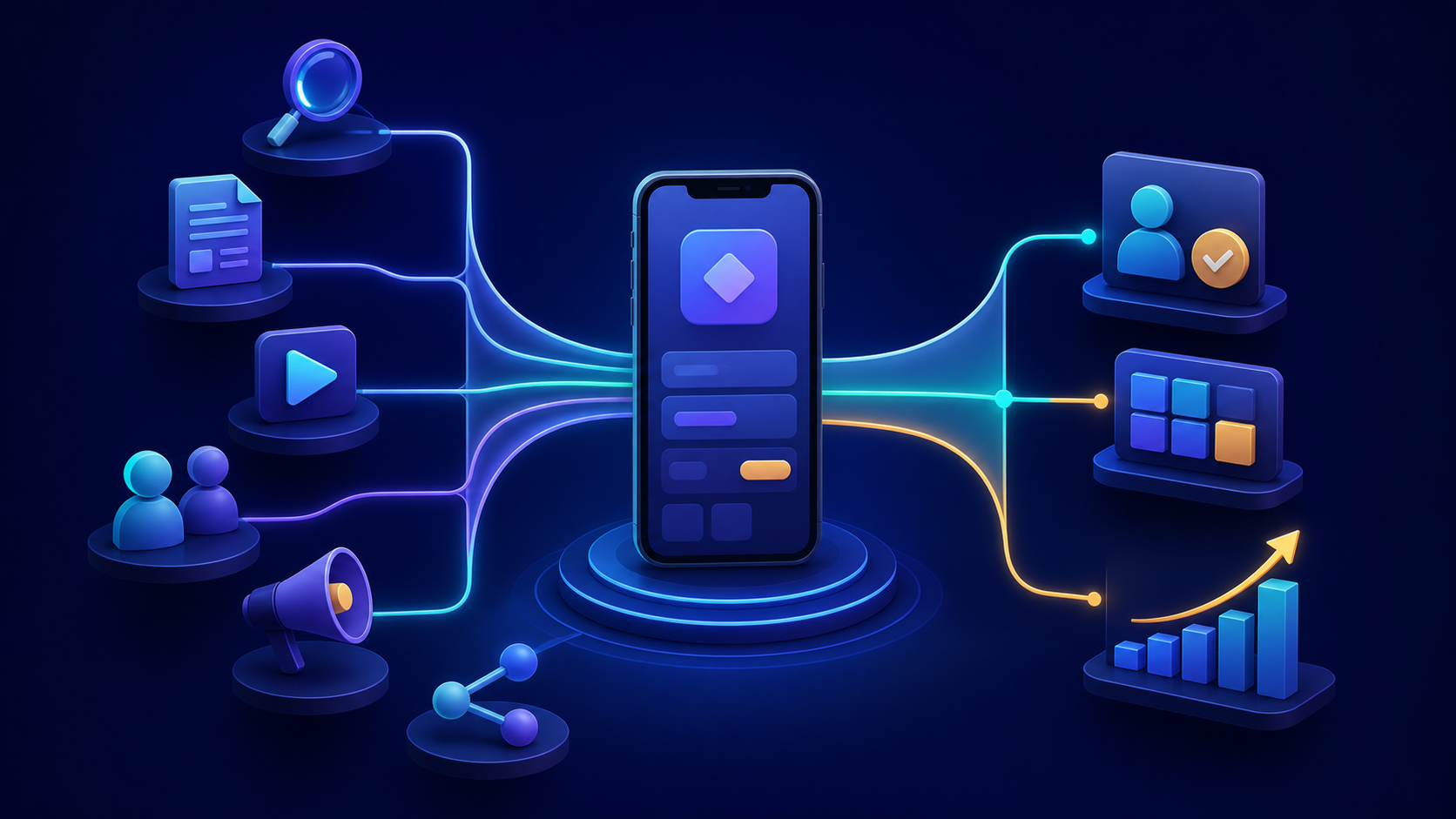
You can ship a useful app, polish the store listing, and still watch launch traffic disappear without producing active users. The hard part of learning how to promote mobile apps is not finding more channels. It is choosing a message, audience, destination, and metric that work together after the click.
The best way to promote a mobile app is to make its value specific, convert store and web visitors efficiently, then combine one compounding organic channel with one measurable paid or partnership channel. Track activation and retained value—not downloads alone—so you can stop weak campaigns and scale the ones that bring the right users.
This guide turns that answer into a practical mobile application marketing strategy. The 12 tactics cover pre-launch through retention, but the sequence matters: establish the measurement loop before you pay to amplify it.
How to promote mobile apps before choosing channels
A list of tactics will not rescue vague positioning or a broken first session. Before selecting ad networks, creators, or communities, write a one-page promotion brief with five decisions:
- Audience: Who experiences the problem frequently enough to seek a solution?
- Promise: What can that person accomplish faster, more cheaply, or more reliably with the app?
- Proof: What product moment demonstrates the promise?
- Activation: Which in-app event shows that a new user reached initial value?
- Economics: What can you afford to spend for an activated or retained user?
Use a sentence that excludes as well as attracts: “For independent language learners who abandon generic courses, this app builds five-minute lessons from their saved vocabulary.” That is more useful than “an AI-powered learning platform for everyone.” It tells the team which search queries, creators, examples, and communities fit.
Then map the path from impression to value:
creative → click → store or landing page → install → first open → activation → retained action
Name one metric at each step. A social team may own qualified clicks, a store team may own product-page conversion, and a product team may own activation. The growth decision should still use the complete path. Cheap clicks that rarely activate are expensive acquisition in disguise.
Treat promotion as a lifecycle rather than a launch event: acquisition, engagement, attribution, retention, and monetization are one continuous system, not five separate budgets. That framing prevents a common planning error—assuming promotion ends when the install completes. An install is the cheapest outcome in the chain and the least predictive of revenue.
12 strategies for how to promote mobile apps
The strongest plan rarely launches all 12 at once. Pick the tactics that match your stage, give each a measurable job, and expand only after you learn where the funnel leaks.
1. Validate the audience and positioning
Interview people who match the intended user, including some who tried a competing product and stopped. Ask about the last time the problem occurred, what they did instead, what triggered the search, and why the existing solution disappointed them. Past behavior produces better campaign language than hypothetical feature preferences.
Turn recurring phrases into three to five message hypotheses. Each should connect one painful situation to one product outcome. For example:
- “Turn saved recipes into an aisle-by-aisle shopping list.”
- “Know which subscription will renew before the charge lands.”
- “Resume the exact workout after an interruption.”
Test those messages in low-cost places: a landing page, a waitlist email, organic posts, search ads with a small cap, or five creator conversations. Measure qualified actions such as waitlist signup or demo completion—not likes. The winner becomes the working promise for the store listing and initial campaigns.
Decision rule: do not scale a message until the people responding resemble the intended audience and can explain the value in their own words.
2. Instrument activation and attribution before spending
Define the events needed to see the whole journey before a launch surge hides the gaps. At minimum, capture campaign click, store or web destination, install or first open, onboarding completion, activation, purchase or subscription, and the retained action that matters for the product.
Agree on event names, timestamps, identifiers, and ownership. Document how consent, iOS privacy controls, Android measurement, web-to-app journeys, and cross-device behavior affect what can be observed. Attribution is an estimate governed by platform rules; it should inform decisions without pretending every install has a perfectly knowable source.
Build a campaign taxonomy such as channel / campaign / audience / creative / destination. Keep the labels stable across ad platforms, analytics, and reporting. Test each route on a real iOS device and Android device, with the app installed and not installed.
Use cohorts to compare downstream quality. The useful question is not “Which campaign generated the most installs?” but “Which campaign produced the most activated users at an acceptable cost, and did those users return or pay?”
Decision rule: block paid scale if a campaign cannot be traced at least to its destination and activation cohort.
3. Build an app store optimization foundation
App store optimization (ASO) helps the right searchers discover the app and helps every referred visitor decide whether to install. Start with the words users employ for the problem, then map them to the app name, subtitle or short description, keyword fields where applicable, long description, and creative assets without forcing repetition.
The first screenshots should tell a short outcome story. Show the user’s desired result, the key action that produces it, and credible supporting detail. Avoid leading with a splash screen or a menu. Localize the message and visuals for markets you actively serve rather than translating one generic listing mechanically.
Apple’s product-page guidance explains how the name, icon, subtitle, previews, screenshots, description, and promotional text contribute to discovery and conversion. Treat those elements as a landing page system, not a compliance form completed once at launch.
Review search terms, product-page views, conversion, and downstream quality on a regular cadence. A keyword that drives visitors but few activated users may be a positioning mismatch, even if ranking improves.
Decision rule: improve the store page before buying more traffic when product-page conversion or new-user activation is weak.
4. Test store creatives and match pages to campaigns
A default store page has to speak to several audiences at once. High-intent campaigns work better when the destination continues the promise made in the ad, email, or creator video.
On iOS, product page optimization can compare alternate icons, screenshots, and app previews with the original page. Apple also supports custom product pages with distinct screenshots, promotional text, previews, and unique URLs for particular features or audiences. Google Play’s custom store listings can tailor names, descriptions, icons, and graphics for defined audience segments.
Test one meaningful hypothesis at a time. “Show meal planning instead of calorie tracking to visitors from the family-budget campaign” is interpretable. Replacing the icon, first screenshot, caption, and video together may raise conversion, but it will not reveal why.
Read test results beside activation and retained value. The page variant that wins the install may attract users with expectations the product cannot satisfy.
Decision rule: promote a variant only when it improves the target action without degrading user quality or creating a misleading expectation.
5. Create a web landing page and useful search content
A website lets you explain the problem in more depth, capture pre-launch demand, earn links, answer support questions, and reach people who begin on the open web. Give each important audience or use case a focused page with one promise, product proof, device-appropriate calls to action, and a working route into the app.
Publish content where the app has genuine authority. A hiking safety app might create offline navigation checklists, route-planning guides, and regional preparation pages. A budgeting app might explain bill calendars, sinking funds, or subscription audits. Each page should solve the searcher’s problem even if they do not install immediately.
Avoid mass-producing thin pages that swap a city or feature name. Start with recurring user questions from interviews, support tickets, community discussions, and store reviews. Link from each guide to the most relevant product experience, not automatically to the home screen.
Decision rule: judge content by qualified visits, assisted installs, activation, and useful backlinks over months—not by first-week traffic.
6. Demonstrate the product through short video and social content
Mobile apps are easier to understand when people can watch the result happen. Record the product solving one problem in a few steps. Begin with the outcome or tension, remove dead time, add legible captions, and adapt the edit to the platform rather than posting the same asset everywhere.
Build repeatable formats:
- a 20-second “before and after” workflow;
- one underused feature applied to a real situation;
- a user question answered with a screen recording;
- a product decision or experiment explained by the builder;
- a short story showing a failed approach and the fix.
Choose one or two networks based on audience behavior. Consumer visual apps may fit short-form video; developer tools may earn better attention through technical posts and demos; niche utilities may benefit from focused forums. Participate before posting promotional links, follow community rules, and answer the question fully.
Give every post one job: earn a profile visit, start a conversation, collect an email, open a relevant web page, or launch an app destination. Tag links consistently so “social” does not become an unhelpful reporting bucket.
Decision rule: continue formats that generate qualified visits or product actions, even if their public engagement looks modest.
7. Work with relevant creators, reviewers, and press
Audience fit matters more than follower count. Build a list of creators, newsletters, podcasts, app reviewers, and trade publications whose audience already experiences the problem. Read or watch their recent work before pitching.
Offer a useful angle rather than asking for generic exposure: early access to a distinctive feature, original category data, an expert demonstration, a subscriber benefit, or a story about how a difficult product constraint was solved. Provide a compact media kit with a one-sentence description, screenshots, short demo, founder or team context, store links, contact details, and clear usage rights.
Track each placement with a distinct link or code, but evaluate more than last-click installs. A niche review may generate branded search, direct traffic, assisted conversions, and reusable proof over time.
If a creator receives money, free access, or another material benefit, disclosure belongs in the brief. The US Federal Trade Commission’s guidance for social media influencers says material relationships should be disclosed clearly and placed with the endorsement.
Decision rule: renew partnerships based on activated or retained users and audience learning, not impressions alone.
8. Launch paid acquisition as a controlled experiment
Paid campaigns can validate messages quickly and scale known demand, but they amplify the conversion path you already have. Begin after store creative, onboarding, activation events, and campaign links pass basic checks.
Choose the channel from intent and creative fit. App-store search ads can reach people already looking for a solution. Search can capture problem-aware demand. Social and video can demonstrate an unfamiliar behavior. App campaigns can distribute assets across a platform’s inventory. Start with a narrow geography or audience, a small set of clearly different creative concepts, and a fixed learning budget.
Optimize toward the deepest reliable event that occurs often enough for the platform and team to learn. An install objective may produce volume; an activation, trial, or purchase objective is closer to the business result. Watch cost per activated user, early retention, payer conversion, revenue, and payback alongside cost per install.
Separate testing from scaling. A testing campaign answers which audience-message-destination combination works. A scaling campaign increases spend on a proven combination while monitoring saturation, creative fatigue, and marginal cost.
Decision rule: set stop, iterate, and scale thresholds before launch so sunk cost does not rewrite the plan.

9. Deep link every campaign to the promised experience
Promotion loses force when a person taps a specific promise and lands on a generic home screen. Use a deep link to open the relevant feature or content for existing users. Use deferred deep linking when a new user should install first and then continue to the intended destination with the necessary context preserved.
Google Ads’ current setup guide for app-campaign deep links describes routing people to relevant app pages and the developer work required for Android App Links and iOS Universal Links. It also documents deferred deep-link setup for supported install campaigns, which makes destination design a joint growth-and-engineering responsibility.
Deeplinkly gives app teams one place to create deep and deferred links, attribute installs, and compare campaign journeys across iOS, Android, and web. Before sending traffic, use the deep-link debugger and test fresh-install, already-installed, signed-out, unavailable-content, old-version, and fallback states.
Keep the destination contract small and versioned. Pass only the context needed to render the next step, validate parameters, and choose a safe fallback. For the technical model behind these routes, see what deep linking means.
Decision rule: do not launch a creative until its CTA reaches the expected destination in every supported install state.
10. Design referrals, sharing, and partnerships into the product
Word of mouth becomes repeatable when the product gives users something genuinely worth sharing and makes the act easy. Identify a natural moment: a completed creation, achieved goal, shared plan, gift, invitation, or useful result. Ask after value is visible, not on first open.
A two-sided incentive can work when both people receive relevant product value, such as extra storage, a trial extension, credit, or collaborative access. Model the cost and abuse cases before launch. Cash-like rewards require stronger fraud controls than a feature unlock.
Partnerships use the same logic at an audience level. Look for complementary products, communities, associations, employers, educators, or creators with a shared use case but no direct conflict. Co-create a workflow, template, benefit, or event rather than exchanging untargeted logo placements.
Give each referral or partner route its own attribution and destination. Measure invites sent, invite acceptance, referred activation, retained quality, reward cost, and suspicious patterns.
Decision rule: scale only if referred users reach value and the loop remains useful without an ever-larger incentive.
11. Re-engage with email, push, and in-app messages
Acquisition spend is wasted if users never finish setup or return to the core action. Build lifecycle messages around behavior: onboarding stalled, a saved item changed, collaborative activity occurred, a trial is ending, a meaningful milestone is near, or new content matches a stated preference.
Choose the least intrusive channel that can do the job. Email can explain and educate. Push works for timely, user-relevant updates. In-app messages guide people who are already active. Every message should state why it matters now, open the exact destination, respect consent and frequency, and stop once the task is complete.
Use a holdout where possible. Users who receive a message may already be more likely to return, so raw conversions can overstate impact. Compare the incremental activation, retention, or revenue lift against opt-outs, disables, complaints, and session disruption.
Decision rule: retire automations that create clicks without incremental product value.
12. Turn reviews, feedback, and retention into promotion
Ratings and reviews affect trust, but the request should follow a real success moment. Ask after a completed task, achieved milestone, or resolved problem—never while the user is blocked. Respect platform controls and do not gate support behind a positive rating.
Apple documents the system-provided requestReview flow, while Android provides an in-app review API designed to keep the review experience within the app. Because the platforms control whether prompts appear, build the product experience around an appropriate moment rather than repeated pressure.
Route negative feedback to a real support and learning process. Tag themes, connect them to app versions and devices, and show users when a reported issue is fixed. Public responses should be concise, respectful, and useful to future readers.
Retention is promotion infrastructure. Satisfied users produce referrals, creator stories, stronger reviews, better testimonials, and more efficient paid cohorts. Fixing a repeated onboarding failure may grow the app more than adding another acquisition channel.
Decision rule: prioritize the product or support issue that repeatedly prevents new users from reaching value.
Choose an app promotion mix by stage and budget
Channel selection should reflect the question the team needs answered now.
| Stage | Primary question | Best starting moves | Avoid |
|---|---|---|---|
| Pre-launch | Does this audience care about this promise? | Interviews, waitlist page, community research, small message tests | Large awareness spend |
| Early launch | Can visitors understand, install, and activate? | ASO, store-page tests, demos, niche outreach, instrumented launch cohort | Optimizing for download volume alone |
| Early growth | Which repeatable channel brings quality users? | Search content, creator tests, referrals, controlled paid campaigns | Expanding to every platform |
| Scaling | Can spend grow without destroying unit economics? | Creative system, deeper event optimization, localized pages, partnerships | Using average CPI as the main decision metric |
| Mature app | Where is incremental growth still available? | Re-engagement, new audiences, cross-promotion, lifecycle experiments | Crediting conversions without holdouts |
With almost no media budget, invest time in positioning, ASO, helpful content, product demonstrations, community participation, referrals, and targeted outreach. Free does not mean costless; measure team hours and opportunity cost.
With a modest budget, pair one organic channel with one paid test. The organic work sharpens language and compounds, while paid traffic accelerates learning. Larger teams can run more tests, but they still need shared event definitions, creative hypotheses, and destination quality.
How to promote mobile apps in a 30-day sprint
Use this plan when the app is live or close enough to test the complete journey.
Days 1–5: establish the baseline
- Define the audience, promise, proof, activation event, and retained action.
- Audit event collection and campaign naming.
- Record baseline store conversion, activation, early retention, and cost metrics.
- Test web, store, deep-link, deferred-link, and fallback routes on both platforms.
- Interview five users or prospects and extract message language.
Days 6–10: fix the conversion surfaces
- Rewrite the first store-page message around the primary outcome.
- Reorder screenshots to show value before navigation.
- Create one campaign-specific store or landing page.
- Improve onboarding at the largest pre-activation drop-off.
- Prepare three creative concepts, each with a distinct promise.
Days 11–20: run two channel experiments
Choose one compounding channel—search content, social demonstration, community, or referrals—and one fast-learning channel such as paid search, app-store ads, a creator placement, or a tightly scoped partnership.
For each experiment, write the audience, message, asset, destination, budget or time cap, primary metric, guardrails, and decision date. Change one major variable at a time. Check routing and data daily, but do not declare winners from tiny samples.
Days 21–25: inspect cohort quality
Compare campaign cohorts through activation and the earliest credible value signal. Review creative-to-page consistency, onboarding completion, errors, refunds or unsubscribes, and qualitative feedback. Separate a weak message from a weak destination or product experience.
Days 26–30: decide and document
Stop the combinations that miss the threshold. Iterate a promising campaign when the failure is diagnosable. Scale a winner gradually while monitoring marginal cost and retained quality. Save what you learned in a simple experiment log so the next cycle begins with evidence.
Measure mobile app promotion as a funnel
Use a small scorecard that connects marketing efficiency to product value.
| Funnel step | Core metric | Diagnostic question |
|---|---|---|
| Attention | Qualified reach or view-through | Did the intended audience notice the message? |
| Interest | Click-through or landing engagement | Did the promise earn the next step? |
| Store/web conversion | Install or signup rate | Did the destination continue the promise? |
| Activation | Cost and rate for the activation event | Did new users experience value? |
| Retention | Cohort return or repeat core action | Did that value persist? |
| Monetization | Trial, purchase, LTV, payback, or ROAS | Did the cohort support the business model? |
| Advocacy | Qualified referral or review rate | Did users value the product enough to recommend it? |
Segment carefully by channel, campaign, creative, destination, platform, geography, app version, and new versus returning user. Do not create so many slices that every result becomes noise.
When several channels touch the same person, compare attribution views and run incrementality tests where the spend justifies them. Platform reporting, an analytics tool, and finance may use different windows and definitions. Reconcile those differences instead of forcing the dashboards to match.
A weekly review should end with decisions: what to stop, what to fix, what to test next, and what to scale. Reporting without a decision is storage, not optimization.
Common mobile app promotion mistakes
- Buying installs before validating activation: the campaign scales a leak.
- Targeting everyone: broad messaging gives no audience a compelling reason to act.
- Sending every CTA to the home screen: users must repeat the work implied by the promotion.
- Changing many variables at once: the team cannot explain a win or loss.
- Treating ASO as a launch task: search language, competitors, and creative performance change.
- Choosing channels by popularity: audience behavior and product format matter more.
- Counting cheap users as good users: CPI hides activation, retention, fraud, and revenue quality.
- Ignoring consent and disclosure: short-term reach creates platform, legal, and trust risk.
- Launching without a stop rule: teams spend past the point where a hypothesis failed.
- Promoting around product friction: more traffic cannot compensate for broken onboarding or weak value.
Frequently asked questions
What is the best way to promote a mobile app?
Start with a specific audience and activation event, optimize the store and onboarding path, then combine one organic channel with one measurable paid or partnership channel. Scale based on activated and retained users rather than installs alone.
How can I promote my app for free?
Use ASO, useful search content, product demos, relevant communities, review outreach, partnerships, referrals, and lifecycle messages. These channels do not require media spend, but they require focused time, consistent contribution, and working measurement links.
Where can I advertise a mobile app?
Common options include app-store search ads, search engines, social and video platforms, ad networks, creator sponsorships, newsletters, podcasts, and complementary apps. Choose the venue where the intended user already seeks the problem, content format, or category your app serves.
How much should I spend promoting an app?
Set a learning budget you can afford to lose, based on your monetization, activation rate, retention, and target payback period. Start small enough to diagnose the funnel, then increase spend only when a campaign produces quality users within a prewritten threshold.
How do I get more app downloads?
Improve discovery through ASO and relevant web content, raise store-page conversion with clearer creative, and send qualified traffic from channels that match the audience. More downloads are useful only when onboarding helps those users reach the app’s core value.
Should app promotion start before launch?
Yes. Pre-launch interviews, positioning tests, a waitlist page, store assets, measurement, creator outreach, and route testing reduce launch-day guesswork. The goal is not manufactured hype; it is evidence that the message and journey work.
How long does mobile app marketing take to work?
Paid and partnership tests can produce directional evidence quickly, while ASO, content, community, referrals, and retention programs compound over longer periods. Set a decision window appropriate to the channel and do not compare a one-week ad test with a long-term organic program on the same timetable.
Conclusion
The practical answer to how to promote mobile apps is to build a learning system, not a longer channel list. Clarify the audience and promise, instrument activation, improve the store and onboarding path, then connect a small number of campaigns to exact destinations and retained outcomes.
For the next sprint, choose one compounding tactic and one fast-learning tactic from this guide. Write their decision thresholds, test every install state, and review the resulting cohorts after they have had time to reach value. Scale only what produces the users your product was built to serve.