

Small app teams rarely lose because they lack channel ideas. They lose because a modest budget gets divided among too many audiences, messages, and experiments to teach them anything. Concentrated marketing offers a disciplined alternative: choose one segment where your app has a credible advantage, build the campaign around that group, and expand only after the economics work.
Concentrated marketing is a targeting strategy in which a company directs one marketing mix toward one well-defined market segment. For a mobile app, that means focusing the audience, promise, creative, channels, onboarding path, and measurement plan on the same priority user—not simply narrowing an ad platform's targeting settings.
This guide shows app marketers and product teams how to choose that segment, test it without confusing focus with guesswork, and measure quality beyond the install.
What is concentrated marketing?
Monash Business School defines concentrated marketing as concentrating a firm's efforts and resources on serving one market segment. It is also commonly called niche marketing, although the two ideas are useful to separate in practice: the niche is the market you serve, while concentration is the decision to focus resources there.
For an app, a segment should describe a group with a shared problem or desired outcome. “People aged 18–34” is a demographic slice, but it usually does not reveal why someone will install, activate, and pay. “First-time freelance designers who need to invoice international clients from a phone” is more actionable because it links identity, context, task, and value.
Concentrated marketing is one of several market-coverage choices. OpenStax's target-market framework distinguishes mass, differentiated, concentrated, and micromarketing approaches.
| Strategy | Audience choice | Campaign design | Best fit for an app team |
|---|---|---|---|
| Undifferentiated | Most of the available market | One broad promise | A simple, widely relevant product with enough budget to build reach |
| Differentiated | Two or more segments | A tailored mix for each segment | A proven app with distinct use cases and capacity to support multiple campaigns |
| Concentrated | One priority segment | One tightly aligned mix | A launch, constrained budget, new geography, or unproven growth hypothesis |
| Micromarketing | Individuals or very small groups | Highly personalized experiences | Mature data and automation programs with sufficient scale and safeguards |
The defining word is one. A team can use several creatives or two closely related channels and still be concentrated if every execution serves the same segment and positioning. Conversely, spending on one channel is not concentrated marketing if the campaign speaks to unrelated audiences.
Why concentrated marketing works for mobile apps
App acquisition creates more opportunities for mismatch than a typical landing-page campaign. An ad can promise one outcome, the store listing can emphasize another, and first open can drop the user into a generic home screen. Focusing on one segment makes those handoffs easier to align.
The potential advantages are practical:
- Clearer positioning: one group, one urgent problem, and one reason to choose the app make creative briefs less generic.
- Denser learning: repeated exposure to the same user problem produces comparable feedback instead of unrelated anecdotes.
- More coherent product journeys: the ad, store listing, deep-linked destination, onboarding, and activation event can all reinforce the same job.
- Simpler budget decisions: a small set of channels and creatives makes it easier to see which variable changed.
- Stronger operating focus: marketing, product, support, and analytics can prioritize the same audience.
Focus does not automatically make acquisition cheap. It removes avoidable variation so the team can learn whether the segment truly works. The strategy can fail if the chosen group is too small, expensive to reach, poorly matched to the product, or dependent on one channel. It can also create concentration risk: a platform policy, seasonal shift, or competitor move may affect most of the pipeline at once.
That is why a concentration strategy should be treated as a bounded growth thesis, not a permanent refusal to serve anyone else.
When should an app use concentrated marketing?
Concentrated marketing is a strong choice when focus increases the quality of learning faster than it limits the available market. It often fits:
- a new app trying to establish its first repeatable acquisition loop;
- a small team that cannot support separate messaging, onboarding, and lifecycle programs for several audiences;
- an established app entering one geography, vertical, or use case;
- a product with an unusually strong advantage for a specific workflow;
- a campaign that must prove post-install value before budget can scale.
It is a weak choice when users across many segments obtain the same obvious value, when the priority segment cannot be reached economically, or when the business needs immediate scale beyond the segment's realistic size. It is also risky if the team chose the segment because it is easy to describe rather than because evidence suggests strong demand and retention.
Use a simple qualification test. A viable segment should score well on five questions:
- Does this group share a specific, recurring problem?
- Does the app solve it noticeably better than a general alternative?
- Can the team reach the group through identifiable channels or communities?
- Can the app recognize activation and downstream value for this group?
- Is the segment large enough to support the campaign's next stage?
If the first four answers are weak, narrowing the audience will only concentrate the uncertainty. If the fifth is weak, the segment may be useful as a beachhead but not as the whole growth plan.
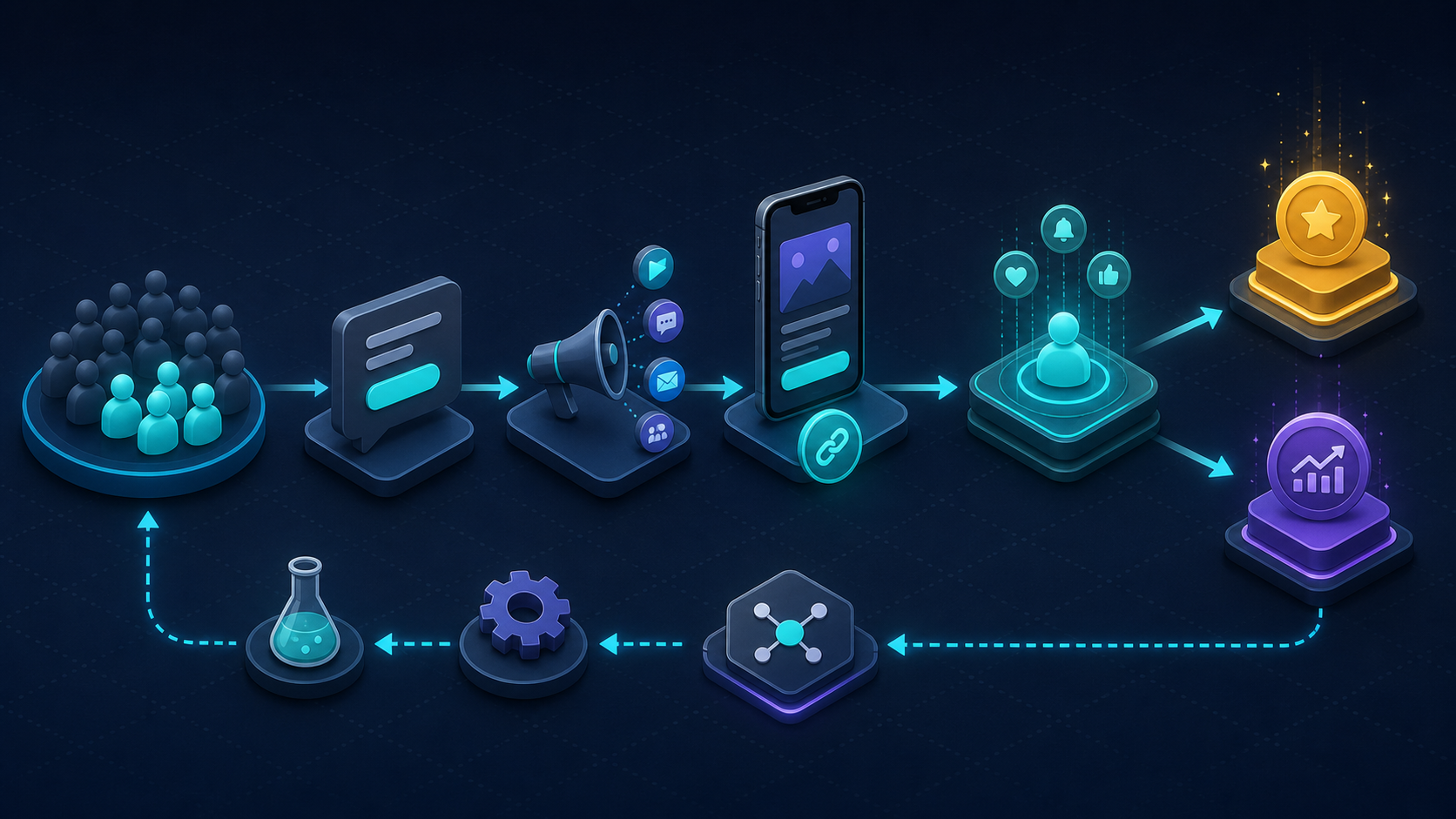
How to build a concentrated marketing strategy for an app
The operational goal is alignment. Segment, offer, channel, destination, experience, and measurement should describe one continuous user journey.
1. Select the segment by problem and behavior
Start with evidence already available: support tickets, app reviews, search queries, onboarding answers, sales notes, retention cohorts, and successful customer interviews. Look for a group that repeatedly expresses the same problem and reaches value in a similar way.
Standard audience definition connects product value to market research, demographics, interests, devices, and observed behavior. That is table stakes. For concentration, go one step further and write a segment statement that a campaign can actually use:
> We are focusing on [specific users] who need to [complete a job] in [context], struggle because [current obstacle], and will recognize value when [observable outcome] happens.
Avoid combining several segments with “and.” “Independent fitness coaches and gym chains” implies different buying processes, workflows, and economics. Pick one for the test.
2. Define the hypothesis and success threshold
Write the thesis before launching creative:
> If we show [segment] a promise about [outcome] in [channel] and route them to [destination], then at least [activation rate] will complete [key event] within [time window], at an acquisition cost below [limit].
This turns “focus on freelancers” into a falsifiable plan. Set a minimum sample or spend, a test period, and stop conditions. Otherwise, teams tend to stop promising tests too early and keep weak ones alive because a few users converted.
Choose a value event deeper than install. The right event might be completing onboarding, creating the first project, inviting a teammate, finishing a lesson, starting a trial, or making a purchase. Google Ads' mobile app conversion guidance separates installs and first opens from custom in-app actions; that distinction matters because a cheap install can still produce no product value.
3. Build one message hierarchy
Translate the segment's problem into a promise, proof, and next action:
- Problem: name the costly or frustrating situation the segment recognizes.
- Outcome: state what changes after using the app.
- Mechanism: explain briefly how the app creates that outcome.
- Proof: show evidence appropriate to the stage, such as a demonstration, rating, customer result, or transparent product detail.
- Action: ask for the smallest meaningful next step.
Create variations around this hierarchy rather than unrelated concepts. A creative test should answer a question—outcome-led versus workflow-led proof, for example—not restart the strategy with a different audience.
Application marketing for mobile products also requires message continuity. Carry the same promise into the store listing and first session. If an ad promotes a budgeting template for freelancers but the store page leads with generic personal finance, the segment has to rediscover the reason to care.
4. Concentrate channels without becoming channel-dependent
Choose channels from observed audience behavior, not from a generic list of popular platforms. Search may suit an urgent task with explicit intent. A specialist newsletter, creator, community, or affiliate may suit a trusted niche. Affiliate marketing for mobile apps can work particularly well when partners already own the segment's attention, but the brief, link structure, payout event, and disclosure expectations must be consistent.
Begin with one primary channel and, if budget allows, one comparison channel. Keep a small reserve for validation and retargeting rather than committing every dollar before the first cohort matures. Concentrating on a segment does not require trusting one distributor forever.
5. Route each promise to the matching experience
Every campaign needs a destination plan for users with and without the app. On Android, verified App Links can open matching app content directly from verified website URLs. Equivalent iOS routing and deferred deep linking help preserve the promised context across install.
Deeplinkly gives app teams one developer-first layer for deep links, deferred routing, and install attribution, so a focused campaign can carry its segment and creative context into the intended in-app screen. The implementation still needs safe fallbacks for logged-out users, unavailable content, older app versions, and desktop visitors.
Do not send every campaign to the home screen. A concentrated strategy earns relevance in the ad and then loses it if the click lands in a generic experience.
6. Measure the journey, not just the audience
Use consistent campaign names and link parameters across creatives, partners, and platforms. At minimum, observe:
impression → click → store view → first open → activation → retention or revenue
Track cost per activated user, activation rate, retained-user rate, and revenue or another value signal alongside CPI. Break results down by creative and channel, but keep the segment definition stable during the initial test.
Google's GA4 app campaign setup connects app events, key events, audiences, and Google Ads optimization. On iOS, expect aggregated and sometimes limited reporting: Apple's AdAttributionKit overview explains that conversion values and source-app information can be conditional when privacy thresholds are not met. Design decisions around cohorts and time windows should account for that uncertainty rather than trying to recreate individual identity.
Compare cohort quality after enough time has passed for the value event. A segment with a higher CPI may still be superior if more users activate, retain, or pay.
7. Decide when to refine, stop, or expand
At the review date, choose one of three actions:
- Refine when the segment activates but one message, route, or channel clearly underperforms.
- Stop when repeated tests cannot reach the agreed unit economics or the segment lacks sufficient demand.
- Expand when the original segment produces repeatable value and an adjacent group shares the core problem.
Expand one dimension at a time. Keep the audience and test a new channel, or keep the channel and test an adjacent segment. Changing both makes it hard to identify why performance moved.
A concentrated marketing example for an app
Imagine a language-learning app that has broad content but limited acquisition budget. Its strongest retained cohort is nurses preparing for English-language licensing interviews. The team chooses that group instead of promoting “learn English” to everyone.
The concentrated campaign might look like this:
| Element | Focused choice |
|---|---|
| Segment | Internationally trained nurses preparing for an English licensing interview |
| Problem | General language practice does not simulate clinical interview vocabulary and pressure |
| Promise | Practice realistic patient and assessor conversations in short mobile sessions |
| Primary channel | Search queries and specialist nursing-exam communities |
| Destination | A clinical-interview lesson pack, not the app home screen |
| Activation | Complete the first simulated interview and review feedback |
| Value metric | Cost per activated learner and trial-to-paid conversion |
| Expansion rule | Add an adjacent healthcare profession only after two cohorts meet the target |
The app itself may still serve travelers, students, and other professionals. Concentrated marketing describes the campaign's resource choice, not necessarily the product's entire eligible user base.
This example also shows the difference between focus and personalization. Everyone in the segment can receive a small set of shared messages and journeys. The team does not need a unique ad for every nurse.
Common concentrated marketing mistakes
Choosing a demographic instead of a need
Age, location, and job title can help find users, but they do not automatically explain product fit. Add the situation, motivation, constraint, and desired outcome.
Treating narrow targeting as the whole strategy
An audience setting cannot align the store listing, destination, onboarding, lifecycle messaging, and product value. Concentration must continue after the click.
Optimizing for the cheapest install
Low CPI can reward low-intent inventory. Use activation, retention, or revenue to judge the segment, and make the event definition stable before comparing campaigns.
Splitting a small budget into too many tests
Testing five audiences, four channels, and six messages at once creates many cells with little evidence. Sequence the uncertainties: validate the segment and promise, then improve delivery.
Ignoring segment size and saturation
A high-performing niche can still cap out. Track frequency, marginal acquisition cost, search demand, partner inventory, and cohort volume. Decide the expansion trigger before saturation forces a rushed pivot.
Scaling before the post-install path works
If users cannot reach the promised screen or the activation event is unreliable, more traffic amplifies waste. Test installed, fresh-install, logged-out, and fallback journeys before increasing spend.
For a broader channel inventory after your first niche is proven, use this guide to promoting a mobile app across paid, owned, and earned channels.
Frequently asked questions
What is concentrated marketing in simple terms?
Concentrated marketing means focusing most campaign resources on one clearly defined customer segment instead of trying to appeal to the whole market. The product may serve other users, but the selected campaign uses one aligned message and marketing mix for the priority group.
What is the main advantage of concentrated marketing?
Its main advantage is focus: a team can align research, creative, channels, user experience, and measurement around one segment. That often makes a limited budget more informative, although it does not guarantee lower acquisition costs.
What is a disadvantage of concentrated marketing?
The business becomes more exposed to the size, demand, channel access, and competitive conditions of one segment. A niche can saturate, shrink, or become expensive, so teams need stop rules and a plan for adjacent expansion.
Is concentrated marketing the same as niche marketing?
The terms are often used interchangeably. A useful distinction is that a niche describes the specialized market, while concentrated marketing describes the strategic choice to focus resources on one selected segment.
How can I promote my app with a small budget?
Choose one segment with a specific need, one measurable promise, and one or two channels where that group already looks for help. Route users to the matching app experience, measure an activation or value event beyond install, and broaden only after the initial cohort meets its target.
When should a concentrated strategy expand?
Expand when repeated cohorts from the initial segment meet the agreed activation, retention, or revenue threshold and the team can identify an adjacent group with the same core problem. Change one dimension at a time so the new result remains interpretable.
Conclusion: earn the right to broaden
Concentrated marketing is not about making an app permanently small. It is about creating enough strategic and measurement clarity to prove one repeatable route to value.
Choose a segment by problem and behavior, keep the promise consistent from ad to activation, and judge the campaign by retained or paying users rather than reach alone. If the cohort works, expand deliberately into an adjacent segment or channel. If it does not, the focused test should tell you exactly which assumption to revisit before spending more.