

Your paid-social dashboard claims the install. Search reports the conversion. An email platform takes credit for the return visit. Meanwhile, your backend shows fewer purchasers than the channel reports combined. Cross-channel marketing attribution is how an app team turns those competing claims into one decision-ready view of the journey.
The goal is not to reconstruct every person's behavior with false precision. It is to preserve the campaign signals you can observe, apply one consistent crediting policy, and state clearly where privacy limits require aggregated reporting or experiments. This guide shows how to build that system for mobile apps, from the first tagged touchpoint to post-install revenue.
What cross-channel marketing attribution means for mobile apps
Cross-channel marketing attribution assigns conversion credit across the marketing channels that influenced an app install, re-engagement, or in-app event. Instead of accepting each platform's self-reported result or giving all credit to the final click, it evaluates eligible touchpoints under one shared set of rules.
For an app, the journey may include a creator's link, a mobile web visit, a paid search ad, an app-store install, a push notification, and a subscription purchase. The measurement challenge is larger than it is on a single website because the route crosses apps, browsers, devices, and an app store where ordinary web cookies do not carry through.
This is why cross-channel attribution is both a data problem and a policy problem:
- Data: Can you retain the source, campaign, creative, timestamps, install, and downstream events without duplicating them?
- Policy: Which touchpoints are eligible, how long are the attribution windows, and how is credit distributed?
- Decision: Will the output change a bid, budget, creative, onboarding flow, or retention campaign?
Google defines attribution as assigning credit for important actions to ads, clicks, and other factors along a user's path. Its current Analytics documentation also makes an important distinction: user-, session-, and event-scoped traffic-source dimensions can follow different attribution rules. Two reports can therefore disagree without either being technically broken.
Cross-channel attribution, multi-touch attribution, and MMM are not synonyms
These methods overlap, but they answer different questions.
| Method | Main question | Best resolution | Key limitation |
|---|---|---|---|
| Cross-channel attribution | Which observed channels and touchpoints receive credit? | Campaign, channel, or touchpoint | Misses activity that cannot be observed or joined |
| Multi-touch attribution (MTA) | How should credit be split across multiple observed touches? | User or path, when signals allow | Sensitive to identity gaps and model assumptions |
| Marketing mix modeling (MMM) | How did channel spend and outside factors relate to outcomes? | Aggregate channel and time period | Less useful for creative- or user-level optimization |
| Incrementality testing | What extra outcome occurred because marketing ran? | Test versus control | Requires careful experimental design and enough volume |
Attribution allocates credit; it does not, by itself, prove that a channel caused the outcome. Current cross-channel guides from StackAdapt and Triple Whale similarly position attribution, MMM, and incrementality as complementary measurement methods rather than interchangeable models.
How cross-channel marketing attribution works end to end
A reliable system follows a conversion backward through a controlled chain of evidence. For mobile apps, that chain normally contains five layers.
1. Capture the marketing touchpoint
Start with a link or impression containing a stable campaign ID and normalized source, medium, campaign, and creative values. Use auto-tagging where a supported platform provides it; use a governed manual convention everywhere else.
Google's current campaign URL guidance recommends a consistent set of relevant UTM parameters and warns that values are case-sensitive. That means Paid_Social and paid_social can become different rows unless your taxonomy prevents the mismatch.
2. Preserve context through routing and the app store
If the app is installed, a deep link should open the intended screen and carry the campaign parameters into the session. If it is not installed, a deferred deep link should route to the correct store and recover allowed context on first open.
On Android, the Google Play Install Referrer API can return the referrer URL plus click and install timestamps. Those signals help a measurement system associate the first app open with the earlier campaign interaction. On iOS, measurement depends on the available consented, platform, and partner signals rather than a shared web cookie.
3. Record one canonical install and downstream events
The app or backend emits the install or first-open event, then meaningful events such as registration, trial start, purchase, subscription renewal, or level completion. Each event needs a durable event ID, UTC timestamp, platform, app version, and business value where applicable.
The attribution platform then matches eligible engagements to the conversion. Its job is not only to count; it must deduplicate competing claims so one install does not become three installs when three networks report it.
4. Apply eligibility and credit rules
The system filters touchpoints by attribution windows, event type, consent state, and channel rules. It then applies the chosen model—for example, last eligible touch, linear, position-based, or data-driven.
Attribution windows matter because a click from yesterday and an impression from three weeks ago should not remain eligible forever. Document separate windows for clicks, views, installs, re-engagements, and the downstream events used for optimization. Windows and methods legitimately vary by engagement type and platform—a tap is stronger evidence than an impression, and privacy frameworks impose their own fixed clocks regardless of what you configure. Our attribution window guide covers how to pick each length from observed conversion lag instead of inheriting a vendor default.
5. Join cost to verified business outcomes
Finally, join normalized campaign cost with attributed installs and backend-confirmed outcomes. Calculate CPI, CAC, payer rate, revenue, retention, LTV, and ROAS from the same grain and currency rules.
A useful report keeps three totals visible: platform-reported conversions, independently attributed conversions, and backend events. Hiding the differences creates a tidy dashboard but removes the evidence you need to debug it.
A mobile journey example
Suppose a user watches a creator video on Monday, clicks a paid search ad on Wednesday, installs the app, and starts a paid subscription after an email reminder on Friday.
- Last-click-to-install gives the install to paid search.
- Last-touch-to-subscription may give the subscription to email.
- Linear attribution could split credit among the creator, search, and email touchpoints if all three are observable and eligible.
- An incrementality test might later show whether the creator program generated additional subscriptions, including conversions whose paths were never joined.
None of those answers is automatically wrong. Each describes a different event, eligibility set, or decision. The mistake is mixing them in one report without labels.
Which cross-channel marketing attribution model should you use?
Choose the simplest model that matches the decision and the quality of your attribution data. Sophistication cannot repair missing campaign IDs, duplicate events, or inconsistent windows.
| Model | Credit rule | Use it when | Do not rely on it when |
|---|---|---|---|
| First touch | 100% to the first eligible interaction | Comparing discovery sources | You need to optimize conversion-closing activity |
| Last eligible touch | 100% to the final eligible interaction | Running tactical acquisition and re-engagement reports | Long consideration paths and assists materially matter |
| Linear | Equal credit to every eligible touch | Establishing a transparent multi-touch baseline | Low-value touches swamp decisive ones |
| Time decay | More credit to touches closer to conversion | Recent nurturing activity is strategically important | Early discovery is the decision you need to fund |
| Position based | More credit to the first and last touches | Discovery and closing both matter | The chosen weights have no business rationale |
| Data driven | Credit estimated from converting and non-converting paths | You have sufficient clean, stable path data | Volume is low or the system cannot explain validation and drift |
Google Analytics' data-driven attribution documentation says its model evaluates converting and non-converting paths and uses factors such as touch timing, device type, sequence, and format. That is a useful reference point, but a platform's model is still bounded by the data that platform can observe.
For a small or mid-sized app team, a practical starting policy is:
- Use last eligible click for operational install and re-engagement reporting.
- Show assisted touches separately rather than forcing arbitrary fractional credit.
- Compare first-touch and last-touch views for discovery-versus-conversion decisions.
- Use holdouts or geo tests for large budget changes and channels with weak path visibility.
- Adopt algorithmic weighting only after you can monitor inputs, model changes, and backtests.
The model should be versioned. When a team changes a window or credit rule, record the effective date and avoid silently rewriting historical decisions.
Why mobile attribution data breaks across channels
Most attribution discrepancies come from predictable differences in identity, eligibility, and event handling—not a mysterious failure in the dashboard.
Privacy removes path detail by design
Apple requires the AppTrackingTransparency framework when an app collects data and shares it with other companies for tracking across apps and websites. The official ATT documentation makes consent a prerequisite for that form of tracking.
Privacy-preserving attribution follows different mechanics. Apple's AdAttributionKit overview describes signed, limited postbacks for installs and re-engagements without tracking individual users or devices across other companies' apps. Because some postback fields depend on privacy thresholds, a null value can be an expected privacy outcome rather than an integration error.
Treat consented user-level, privacy-preserving postback, and modeled data as distinct signal classes. Do not join them into a person-level path unless the identifier and purpose permit it.
Platforms grade their own work
An ad network sees its own impressions and clicks, applies its own windows, and may include modeled or view-through results. An independent attribution system sees a different signal set and deduplicates across networks. Your backend sees completed business events but may know nothing about the eligible marketing touches.
Expect totals to differ. Reconciliation should explain the delta by window, timezone, event definition, re-attribution rule, rejected traffic, reporting delay, and signal availability.
Cross-device paths are incomplete
A person may research on a laptop, click an email on a phone, install on a tablet, and purchase after signing in. A first-party account can connect some of that journey after authentication, but anonymous pre-login activity may remain separate.
Use deterministic first-party joins only when you have an appropriate identifier and lawful purpose. Label probabilistic or aggregate estimates. A dashboard that conceals uncertainty is less useful than one that shows it.
Event and naming drift corrupts clean-looking reports
trial_started, start_trial, and free_trial may represent the same business action. A purchase may fire from both the client and server. A redirect may strip a campaign ID. These defects often create more actionable error than the attribution model itself.
A cross-channel marketing attribution implementation playbook
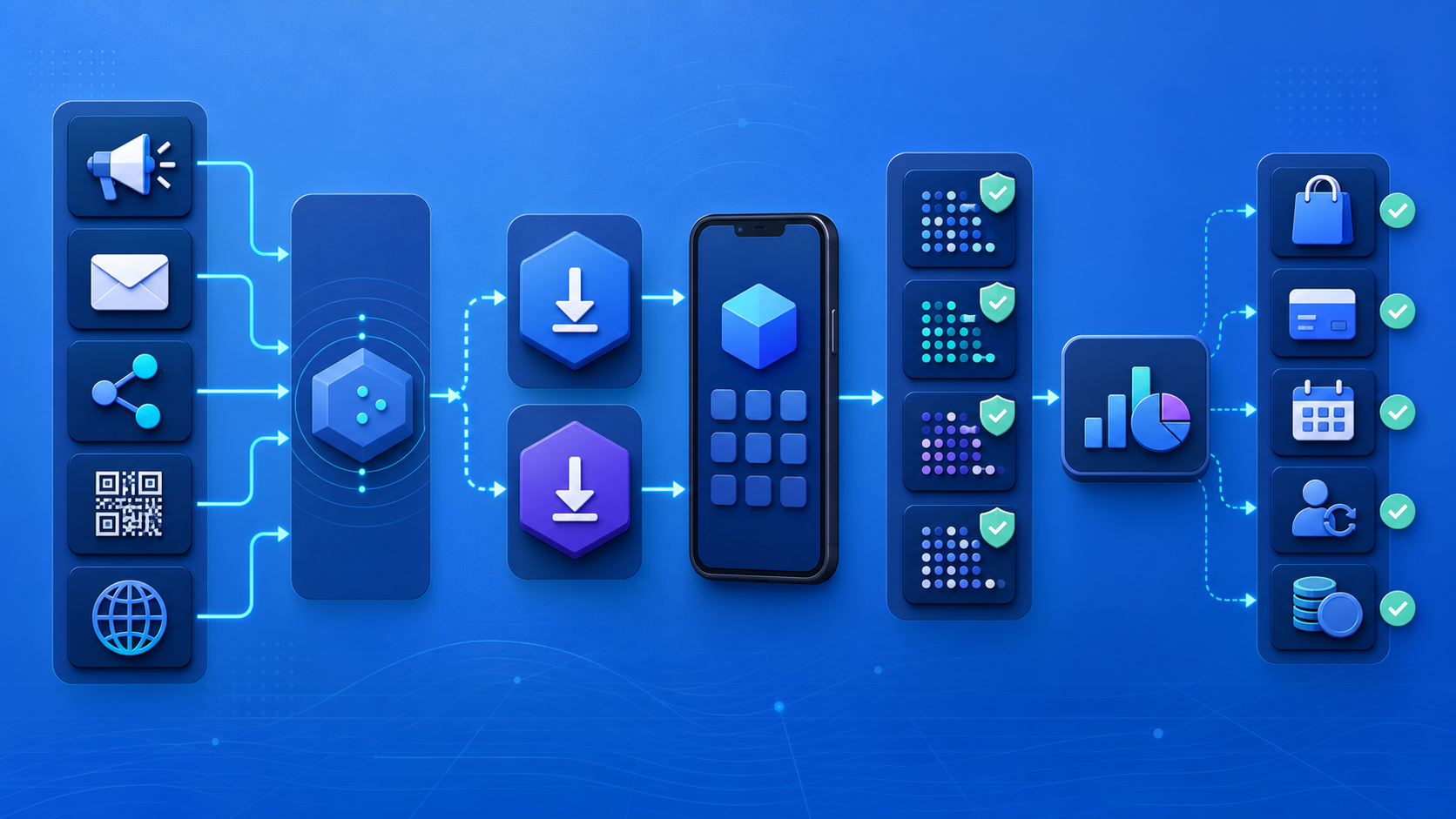
Build the system in this order so that each layer can be tested independently.
Step 1: Define the decision and conversion hierarchy
Write down the decisions the report must support: pause a creative, move budget between channels, optimize to paid subscribers, or measure re-engagement. Then define a small event hierarchy:
- Acquisition: click, store visit, install, first open
- Activation: registration, onboarding complete, trial start
- Value: purchase, subscription, ad revenue, key product action
- Retention: session, renewal, repeat purchase, milestone
Make backend-confirmed revenue the authority for financial outcomes. Client events can be faster, but server validation protects reporting from retries, offline behavior, and tampering.
Step 2: Govern campaign naming before generating links
Create a data dictionary for channel, source, campaign_id, campaign_name, ad_set, creative, country, and owner. Use controlled lowercase values, stable IDs, and explicit handling for unknown fields.
Google explains that traffic-source dimensions can come from manual tags, auto-tagging, integrations, and aggregate identifiers. Your taxonomy should map all of those inputs into one internal channel grouping while retaining the raw values for audit.
Step 3: Use one measurable link path for owned and paid channels
Generate trackable links for paid ads, email, SMS, QR codes, creators, affiliates, and referrals. Test both installed and not-installed routes on real iOS and Android devices. Preserve the original campaign ID across redirects and pass only the context the destination needs.
This is also where deep linking improves more than attribution: it sends the user to the promised product, offer, or content rather than the app home screen. Review the mechanics in Deeplinkly's mobile deep linking guide and use the deep-link debugger before a campaign ships.
For teams that want routing and measurement in one developer-first stack, Deeplinkly creates deep and deferred deep links, attributes installs and downstream activity, and exports raw data through CSV, APIs, or webhooks. That keeps the campaign context and event record available for reconciliation without requiring a separate link layer.
Step 4: Instrument once, deduplicate everywhere
Assign a globally unique ID to every conversion event. If the client sends an event immediately and the backend later confirms it, use the same ID or a documented merge key so the pair becomes one conversion.
Build automated checks for:
- Duplicate event IDs and impossible timestamp order
- Missing campaign IDs or sudden growth in
unknown - Install counts that exceed first opens beyond an agreed tolerance
- Revenue totals that do not match the payment system
- Source values outside the data dictionary
- Redirects that drop query parameters
- SDK or app-version changes that alter event volume
Step 5: Standardize windows, timezones, and currency
Create a measurement contract shared by marketing, product, data, and finance. It should state the reporting timezone, currency conversion rule, click and view windows, re-engagement rules, late-event policy, and definition owner.
Keep raw timestamps in UTC, then apply the reporting timezone at query time. Store original currency and normalized currency. Those details sound mundane until a midnight boundary or exchange-rate rule moves enough revenue to reverse a channel decision.
Step 6: Build reconciliation into the dashboard
Do not aim for a magical zero discrepancy. Aim for an explained discrepancy.
For every channel and day, display:
- Ad-platform spend and reported conversions
- Independently attributed installs and events
- Backend-confirmed conversions and revenue
- Absolute and percentage deltas
- The top known reason codes
Then investigate changes, not merely high deltas. A stable 12% difference with a known window explanation may be less urgent than a shift from 3% to 9% after an SDK release.
Step 7: Validate budget decisions with experiments
Use attribution for daily optimization and path diagnosis. Use experiments when the decision is causal and expensive: increasing creator spend, cutting branded search, launching CTV, or turning off a retargeting channel.
A holdout, geo test, or other controlled design asks what happened without the marketing exposure. Compare that result with attribution. If both point in the same direction, confidence rises; if they disagree, investigate audience overlap, unobserved impressions, selection bias, and model assumptions before reallocating the budget.
What a useful cross-channel report should show
A decision-ready dashboard does not need dozens of tabs. Start with one channel table containing spend, attributed installs, activated users, payers, revenue, CAC, D7 or D30 retention, and ROAS. Add first-touch, last-touch, and assisted-conversion views only when they answer a named decision.
Include data-quality indicators beside performance:
- Percentage of events with a known campaign ID
- Percentage of conversions using deterministic, privacy-preserving, modeled, or unknown signals
- Duplicate and rejected-event rates
- Median reporting delay
- Platform-to-attribution and attribution-to-backend deltas
- Model and attribution-policy version
Review operational metrics weekly and audit the measurement contract monthly or after any SDK, consent, link-routing, store, or channel integration change. The point of attribution tracking is not to crown a permanently winning channel. It is to make the next budget decision with consistent evidence.
Frequently asked questions
What is an example of cross-channel marketing attribution?
A user discovers an app through a creator, clicks a paid search ad before installing, and later subscribes after an email. Cross-channel attribution records the eligible interactions and applies one model to decide whether search gets install credit, email gets subscription credit, or the touches share credit.
Is cross-channel attribution the same as multi-touch attribution?
No. Cross-channel attribution is the broader practice of measuring contribution across channels. Multi-touch attribution is one approach for distributing credit among multiple observed interactions within that practice.
What data is needed for cross-channel attribution?
At minimum, collect stable campaign IDs, source and medium, touch timestamps, install or first-open events, downstream conversion IDs, and verified business value. You also need documented attribution windows, event definitions, consent handling, and deduplication rules.
Can cross-channel attribution work without tracking individual users?
Yes, but the output becomes more aggregate. Privacy-preserving postbacks, channel-level reporting, MMM, and controlled experiments can measure performance without building a person-level path; the dashboard should identify which signal type supports each result.
Why do ad platforms and an MMP report different conversion totals?
They observe different signals and use different attribution windows, eligibility rules, timezones, reporting delays, and modeling methods. An MMP also deduplicates claims across networks, while each network normally reports from its own perspective.
How often should an app team change its attribution model?
Change it only when the business decision, data quality, or channel mix has materially changed. Version the new policy, test it against historical data, record the effective date, and avoid comparing periods as though the definitions were identical.
Build a measurement system you can explain
The right cross-channel marketing attribution setup is not the model with the most complex math. It is the system your marketing, product, data, and finance teams can trace from campaign link to verified outcome—and whose blind spots are visible.
Start with governed campaign IDs, reliable deep-link routing, deduplicated backend events, and one documented last-touch baseline. Add assisted views, privacy-preserving signals, and experiments as your decisions demand them. If you need a mobile-first link and attribution layer that preserves campaign context through install, review Deeplinkly's pricing and implementation options against that checklist.