

A shopper taps a product in a social post, installs the retailer's app, and expects to see that exact product—not a home screen. If your team is trying to define m commerce, that short journey captures both the opportunity and the operational challenge: the sale happens on a mobile device, but its context can cross ads, websites, app stores, apps, wallets, and backend systems.
This guide explains what m-commerce includes, how it differs from e-commerce, and how to measure the path from mobile discovery to revenue.
Define m commerce: the plain-English meaning
M-commerce, short for mobile commerce, is the buying and selling of goods or services through a handheld mobile device such as a smartphone or tablet. It covers transactions in mobile websites and apps as well as device-enabled payments, banking, ticketing, subscriptions, and other commercial activity.
M-commerce is a subset of e-commerce rather than a separate economic model. E-commerce includes transactions completed on any connected device; m-commerce narrows the channel to phones and tablets. That distinction matches the definitions used by the Cambridge Business English Dictionary and TechTarget.
The transaction does not have to happen in a native app. Buying through a mobile browser counts too. What makes the experience mobile commerce is the device and journey: touch-first discovery, a small screen, mobile identity or wallet options, and the expectation that the next action works immediately.
Define m commerce by its three main types
Most definitions group mobile commerce into mobile shopping, mobile banking, and mobile payments. In practice, these categories overlap, so it is more useful to treat them as jobs a customer completes than as rigid industries.
1. Mobile shopping
Mobile shopping covers physical or digital purchases through a mobile website, marketplace, social platform, or native app. Examples include ordering groceries in a retailer app, booking a ride, buying a ticket from a mobile site, paying for delivery, or purchasing an in-app subscription.
This category also includes journeys that begin outside the store. A customer may discover an item in search, an ad, an email, a creator's post, or a shared link before opening the product page. The commercial experience therefore starts at the tap, not at checkout.
2. Mobile banking
Mobile banking lets customers review balances, transfer money, pay bills, manage cards, or complete other financial transactions on a phone or tablet. It is a form of m-commerce, but m-commerce is broader than banking: retail, travel, food delivery, entertainment, and marketplace transactions also qualify.
3. Mobile payments
Mobile payments use the device to authorize or facilitate payment. The customer might use a digital wallet during app checkout, tap a phone at a contactless terminal, scan a payment code, or send money through a payment app. Apple's current Apple Pay guidance describes support for physical goods, services, donations, and subscriptions in apps and browsers, while directing digital content sold inside apps to in-app purchase.
Another useful classification is by surface: mobile web, native app, or in-person payment. Mobile Transaction's overview uses those surfaces to show why m-commerce extends beyond a conventional online store.
Common m-commerce examples
An m-commerce transaction can be as obvious as buying shoes in a retail app or as brief as unlocking a scooter. Common examples include:
- purchasing a physical product through a mobile website or shopping app;
- ordering food, groceries, transport, or another on-demand service;
- buying event, airline, or public-transport tickets on a phone;
- paying for a subscription or permitted digital item in an app;
- transferring money or paying a bill in a banking app;
- using a wallet for app, web, QR-code, or contactless checkout;
- buying through a marketplace or a social commerce experience;
- redeeming a loyalty offer that leads to a mobile purchase.
Merely browsing a product page on a phone is mobile shopping behavior, but it is not yet a completed commerce transaction. Product views and cart additions still matter because they reveal where intent builds or disappears before purchase.
Define m commerce versus e-commerce
The easiest rule is: all m-commerce is e-commerce, but not all e-commerce is m-commerce. A desktop order is e-commerce. The same order completed on a phone is both e-commerce and m-commerce.
| Dimension | M-commerce | Broader e-commerce |
|---|---|---|
| Primary device | Smartphone or tablet | Any connected device, including desktop and laptop |
| Interaction | Touch-first, compact, often interrupted | More screen space and easier side-by-side research |
| Discovery | Search, social, messaging, QR codes, push notifications, apps | Search, email, websites, marketplaces, and other digital channels |
| Checkout | Often uses stored credentials, wallets, or biometrics | May use wallets or conventional form-based checkout |
| Native capabilities | Camera, location, notifications, wallet, biometrics | Browser and desktop capabilities vary |
| Measurement challenge | App-to-web, store-install, and cross-app handoffs | Primarily browser and cross-device handoffs |
Stripe's comparison of m-commerce and e-commerce emphasizes that the difference changes interface design, session behavior, checkout, and device-native features—not just screen size. A mobile strategy should therefore do more than shrink a desktop storefront.
How an m-commerce journey works
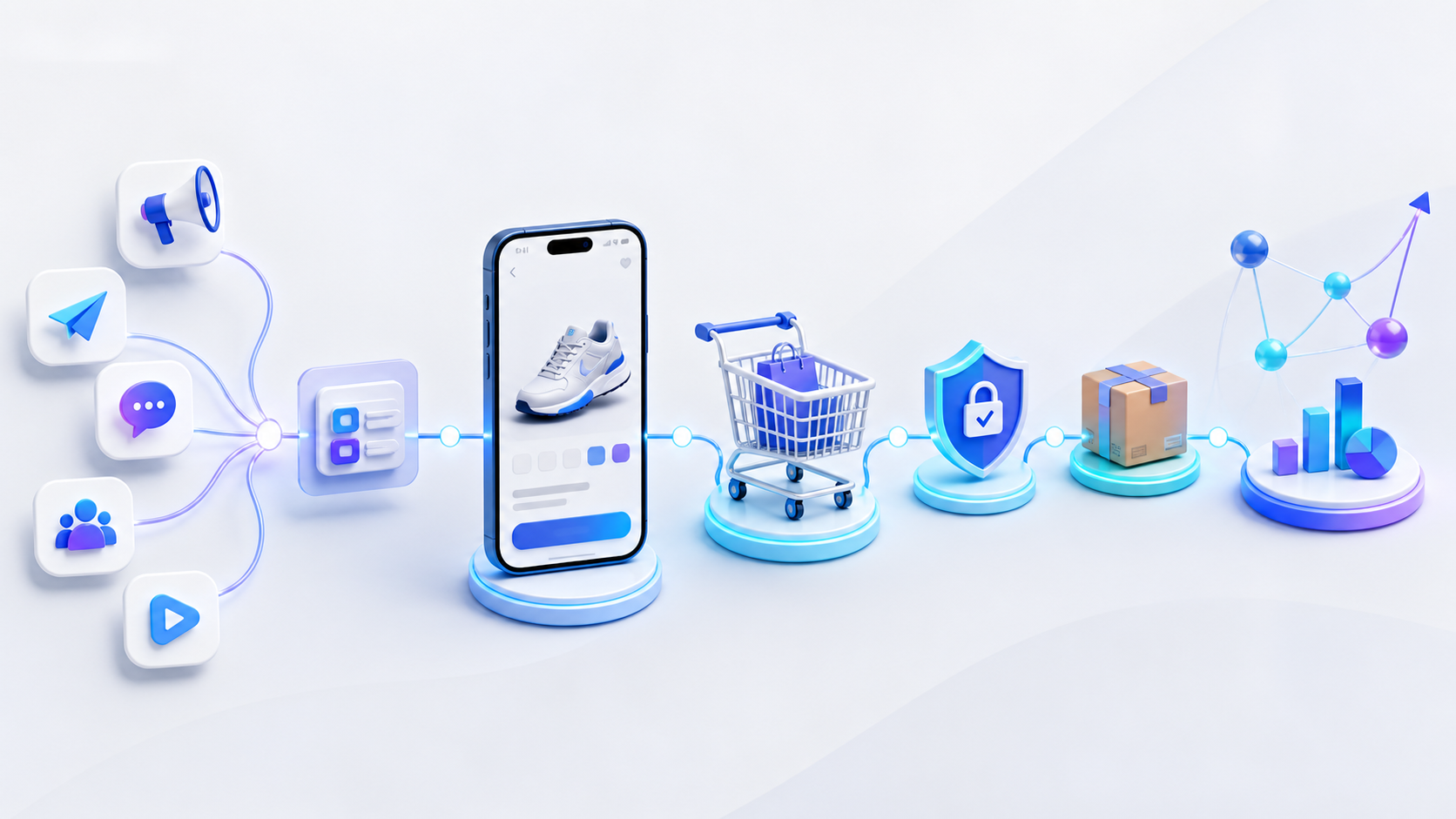
A measurable mobile commerce journey usually has five stages:
- Discovery: A customer sees a product or offer in search, social, an ad, email, messaging, a referral, or a QR code.
- Routing: The link opens the relevant mobile web page or app screen. If the app is absent, the journey may pass through an app store before first open.
- Evaluation: The customer views the item, checks price and delivery, saves it, or adds it to a cart.
- Checkout: The customer supplies shipping and payment details, uses a wallet, and confirms the order.
- Fulfilment and retention: The business confirms the transaction, delivers the product or service, and may bring the customer back for another purchase.
Routing is easy to underestimate. Apple's universal-link documentation explains that one standard web URL can open matching content in an installed app or fall back to the website when the app is unavailable. Android App Links similarly use a verified association between a website and app to route matching URLs directly to app content.
If a campaign promotes a specific product but the tap opens a generic home screen, the customer must repeat the search. If an install is required and the product or promotion context disappears at the app store, the journey becomes even harder to complete and attribute.
Benefits and risks of mobile commerce
M-commerce can compress discovery and payment into a fast, personal flow. Customers can act wherever they are, while businesses can use mobile-friendly checkout, saved preferences, loyalty, notifications, and device capabilities to reduce unnecessary steps.
The same qualities create risks:
- Small-screen friction: crowded navigation, slow pages, and long forms are harder to tolerate on a phone.
- Broken handoffs: ads, browsers, stores, apps, and payment providers may lose the intended destination or campaign context.
- Inconsistent payment support: wallet and payment availability varies by device, country, and product type.
- Security and privacy obligations: teams must validate link inputs, minimize collected data, secure payment flows, and respect platform and consent requirements.
- Fragmented measurement: ad platforms, app analytics, commerce backends, and finance systems may count or date the same purchase differently.
Apple specifically warns developers to validate universal-link parameters and reject malformed URLs because incoming links can become an attack path. Convenience should shorten the route to a safe action, not bypass authorization or expose customer data.
How to measure m-commerce from tap to revenue
Revenue alone tells you what happened, but not where the journey broke or which source brought the customer. Start with one shared funnel and give every important event a stable name and owner.
Instrument the commerce funnel
For a retail journey, a useful event sequence is:
product_view → add_to_cart → begin_checkout → add_payment_info → purchase
Google Analytics recommends equivalent e-commerce events such as view_item, add_to_cart, begin_checkout, add_payment_info, purchase, and refund. Its e-commerce setup guidance also recommends passing transaction and item data so teams can understand product and promotion performance.
Record purchases from a trusted backend or payment confirmation when possible. Use a transaction ID to deduplicate retries and events sent by both the app and server. Store currency with revenue, and decide whether dashboards show gross order value, net revenue, recognized revenue, or another finance-approved definition.
Track the metrics that answer a decision
| Question | Metric | Basic calculation |
|---|---|---|
| Do product views become orders? | Purchase conversion rate | Purchases ÷ eligible visitors or sessions |
| Does checkout create friction? | Checkout completion rate | Purchases ÷ checkout starts |
| How much is each order worth? | Average order value (AOV) | Revenue ÷ orders |
| Which campaigns acquire buyers efficiently? | Customer acquisition cost (CAC) | Campaign cost ÷ new customers |
| Does media return more than it costs? | Return on ad spend (ROAS) | Attributed revenue ÷ ad spend |
| Do acquired customers keep creating value? | Lifetime value (LTV) | Cohort revenue or margin over the chosen horizon |
| Does routing preserve intent? | Deep-link destination rate | Correct destination opens ÷ eligible link opens |
Avoid optimizing a metric without its guardrail. A campaign can produce cheap installs but few buyers, a promotion can lift conversion while reducing margin, and a wallet button can improve checkout while an incorrect purchase event inflates revenue.
Connect acquisition context to purchase events
Deep links should carry approved campaign and destination data into the app. Deferred deep links should restore the intended context after a first-time install when the platform and implementation permit it. Attribution then connects that acquisition record to downstream events without treating the payment ledger as a marketing dashboard.
Deeplinkly's app attribution platform combines deep links, deferred routing, install attribution, funnel analytics, and raw exports in one developer-first setup. That is useful when an app team needs to trace a campaign tap to a product destination and purchase while keeping the underlying event data available for reconciliation.
Use your commerce backend as the transaction truth, your product analytics to understand behavior, and your attribution layer to apply campaign context. The systems do not need identical totals, but their definitions, time zones, deduplication rules, and reporting windows should explain the difference. For a deeper primer, see what a mobile measurement partner does and how to evaluate mobile attribution models.
M-commerce implementation checklist
Before sending a live campaign into a mobile shopping flow:
- Map the exact destination for every product, category, offer, and referral link.
- Test installed-app, mobile-web, and first-install routes on both iOS and Android.
- Keep product and promotion context through permitted handoffs.
- Define canonical item-view, cart, checkout, purchase, refund, and revenue events.
- Add a stable transaction ID and confirm retry behavior does not duplicate orders.
- Validate currency, tax, discount, shipping, and refund handling with finance.
- Reconcile campaign, analytics, backend, payment, and finance reports on the same date basis.
- Measure destination success and funnel conversion by channel—not clicks alone.
- Test malformed links, expired offers, unavailable products, and safe web fallbacks.
- Monitor event-volume drops, unknown sources, checkout failures, and sudden revenue variance.
Start with one real campaign and one product journey. A narrow end-to-end test finds more actionable problems than a broad dashboard review with undefined events.
Frequently asked questions
What does m-commerce stand for?
M-commerce stands for mobile commerce. It means buying and selling goods or services through handheld mobile devices such as smartphones and tablets.
What is an example of m-commerce?
Buying a product in a retailer's mobile app is m-commerce. Other examples include ordering food on a phone, using mobile banking, paying with a digital wallet, buying a mobile ticket, or completing checkout in a mobile browser.
What are the three main types of m-commerce?
The three commonly cited types are mobile shopping, mobile banking, and mobile payments. Another practical classification separates mobile-web, native-app, and in-person mobile transactions.
Is m-commerce the same as e-commerce?
No. M-commerce is the mobile subset of e-commerce. E-commerce covers online transactions on any connected device, while m-commerce specifically covers transactions made through smartphones and tablets.
Is mobile banking the same as m-commerce?
No. Mobile banking is one type of m-commerce. M-commerce also includes retail purchases, on-demand services, ticketing, subscriptions, marketplaces, and mobile payments.
How should an app team measure m-commerce?
Track the journey from campaign tap and destination open through product view, cart, checkout, purchase, and refund. Reconcile transaction IDs and revenue with the commerce backend, then use attribution data to compare conversion, CAC, ROAS, and customer value by source.
Conclusion: define the journey before optimizing it
To define m commerce is to identify commerce conducted through a smartphone or tablet—but that definition is only the starting point. For an app team, the real system spans discovery, routing, evaluation, payment, fulfilment, and measurement.
Map one customer path from tap to confirmed revenue. Then test every handoff, standardize the events, and reconcile the purchase with its acquisition context. That gives product, growth, and finance teams a shared view of where mobile revenue comes from and what to improve next.