

Your ad network reports 12,400 installs. Your MMP reports 10,900. The backend sees 9,700 first opens, and the retailer holding the purchase data cannot send you raw customer records. Data collaboration platforms help teams work across those boundaries without building another spreadsheet-based source of truth—or handing sensitive event data to every partner.
For a mobile attribution team, the real question is not whether more data would be useful. It is whether a platform can match the right records, enforce each party's rules, explain discrepancies, and return an output that can change a campaign decision.
What are data collaboration platforms?
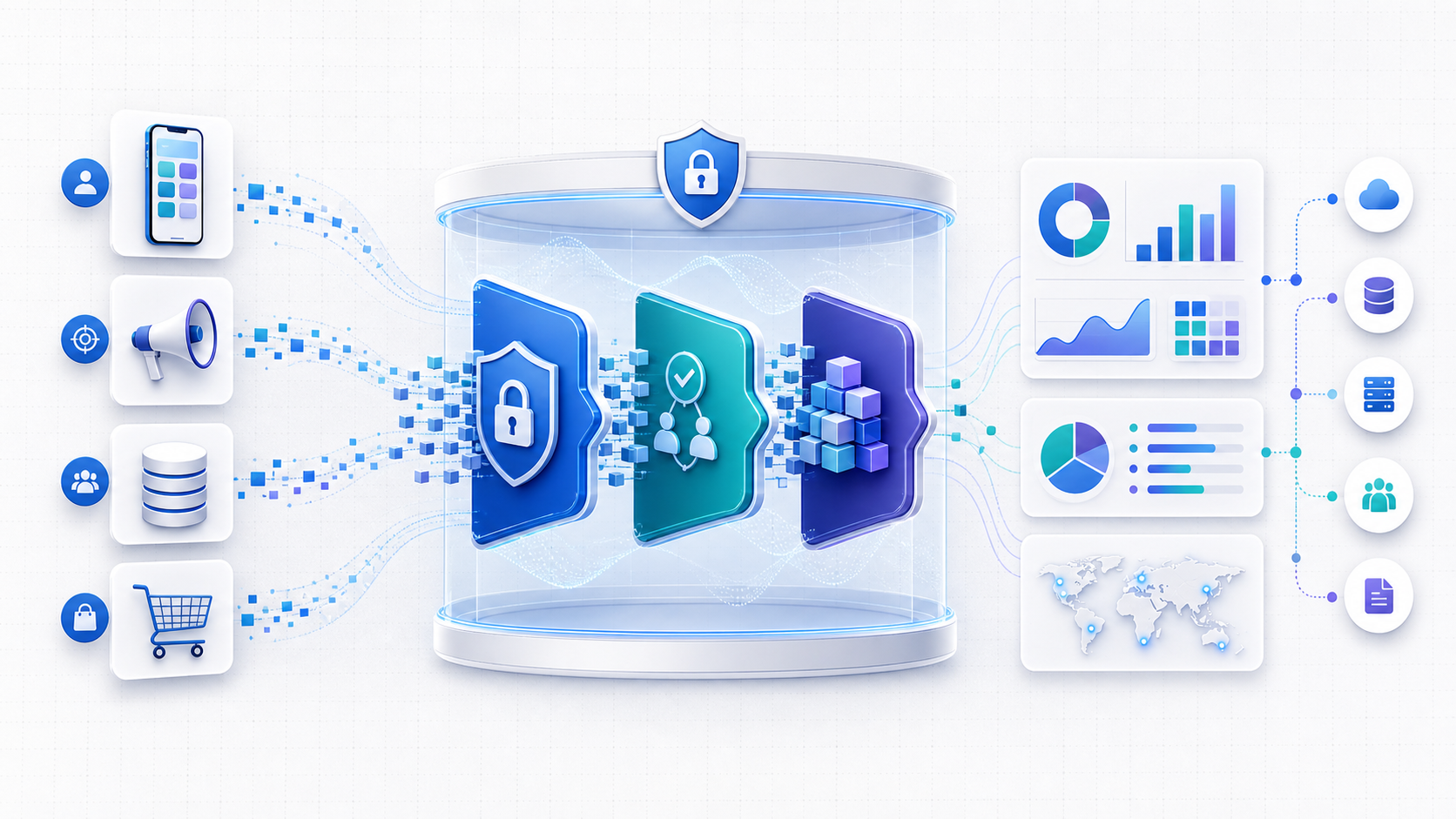
Data collaboration platforms are governed environments where teams or partner organizations combine, match, and analyze permitted datasets without exposing unrestricted raw records. They extend the secure computation of a data clean room with workflows for data connection, identity matching, measurement, audience creation, activation, and controlled export.
That definition matters because “collaboration” is broader than moving tables into one warehouse. An advertiser may contribute campaign and conversion events, while a publisher contributes exposure data. The platform applies agreed matching keys, query rules, aggregation thresholds, and output permissions so both sides can answer a shared question while retaining control of their inputs.
In mobile marketing, common questions include:
- Which publisher exposures led to an install or in-app purchase?
- How much reach was duplicated across app, web, CTV, and retail media?
- Which high-value customer traits overlap with a partner's audience?
- Can a campaign be activated from an approved segment without exporting the underlying profiles?
The IAB Tech Lab's Attribution Data Matching Protocol illustrates the core attribution pattern: advertiser conversions and publisher engagements are mapped to common keys, attribution is computed, and privacy-safe aggregate output is released. The specification also treats DCPs, MMPs, CDPs, and attribution platforms as possible delegated vendors rather than interchangeable products.
Why mobile attribution data becomes fragmented
Mobile measurement rarely has one universally “correct” number. Different systems can observe different events, apply different definitions, and report them on different dates.
Apple requires apps to use App Tracking Transparency when data is collected and shared for tracking across other companies' apps or websites, according to Apple's developer documentation. That limits the deterministic identifiers available for some iOS journeys. At the same time, ad platforms may include modeled conversions or view-through credit that an independent measurement system cannot reproduce at user level.
Even on a fully consented journey, operational differences remain. Google's app attribution discrepancy guide lists several: Google Ads reports by the date of the ad interaction while many third parties report by conversion date; Google Play installs and third-party first opens are different events; time zones, re-installs, processing delays, count settings, and lookback windows can all change the total.
This means a data discrepancy is not automatically evidence of a broken SDK or dishonest partner. It is a reconciliation problem until the team aligns:
- the event being counted;
- the timestamp used for reporting;
- the attribution window and model;
- the identity or match key;
- deduplication and invalid-traffic rules;
- consent eligibility and aggregation limits.
A DCP creates a governed place to make those rules explicit. It does not erase the differences, but it can make them explainable and repeatable.
Data collaboration platform vs. clean room, CDP, MMP, and warehouse
These tools overlap, but buying one as a substitute for another usually creates a capability gap.
| Tool | Primary job | Typical data boundary | Best attribution role | Common limitation |
|---|---|---|---|---|
| Data warehouse | Store and query company data | One organization | Internal event analysis and modeling | External partners must still share or replicate data |
| CDP | Maintain unified customer context for downstream use | Mostly one organization | First-party identity and audience preparation | Not purpose-built for multi-party governed analysis |
| MMP | Attribute mobile clicks, installs, and in-app events | Advertiser plus integrated networks | Operational mobile attribution and postbacks | May not support arbitrary partner data joins |
| Data clean room | Run approved analyses without revealing raw partner data | Multiple organizations | Privacy-enhanced matching and aggregate measurement | Outputs may require separate orchestration and activation |
| Data collaboration platform | Coordinate partner connection, governance, analysis, measurement, and activation | Multiple organizations | Repeatable cross-partner attribution workflows | More cost and process than a single-party team may need |
The CDP Institute's current definition emphasizes a persistent, unified customer record that is accessible to other systems. A clean room is different: it constrains what collaborators can query and receive. A DCP usually wraps that protected analysis layer in partner discovery, templates, identity options, orchestration, and destinations.
The distinction is not merely semantic, but it is also not settled. IAB Tech Lab publishes data clean room guidance and recommended practices precisely because definitions and controls vary between vendors, and its updated guidance exists in part to clarify how clean rooms differ from other data collaboration solutions. Treat any vendor's category label as a starting point and verify the actual matching method, query restrictions, output controls, and governance yourself.
How data collaboration platforms work for mobile attribution
A useful DCP workflow has six stages. Each stage should be testable in a proof of value.
1. Define the decision before connecting data
Start with a question such as, “How many purchasers were exposed to publisher campaign A within seven days before first purchase?” Specify the eligible event, attribution window, exclusions, required breakdowns, and minimum actionable output.
This avoids the expensive pattern of loading every available field and hoping an insight appears. It also gives privacy and legal teams a concrete purpose to assess.
2. Prepare first-party attribution data
Standardize campaign IDs, event names, timestamps, currencies, consent flags, and deletion states before any join. Keep an immutable source event ID so results can be reproduced without counting the same conversion twice.
If your immediate gap is trustworthy first-party attribution rather than external partner joins, a full DCP may be premature. Deeplinkly's app attribution platform can centralize clicks, installs, and downstream events, expose raw data through CSV, API, and webhooks, and pair the measurement record with deep links; that gives teams a governed baseline to take into future collaborations. Add a DCP when you need to query a publisher's or retailer's data without exchanging raw records.
3. Match only eligible records
The platform maps agreed identifiers—such as a pseudonymized login, hashed contact value, or permitted device signal—without giving every participant the joined row set. Match-rate reporting should distinguish eligible records, formatted records, matched records, and records suppressed by policy.
A single “match rate” percentage is not enough. Ask for the numerator, denominator, hashing and normalization steps, and whether the identity method works across the partners and geographies you actually use.
4. Apply policy and privacy controls
Controls can include role-based permissions, approved query templates, column restrictions, minimum group sizes, query logs, differential privacy, and cryptographic computing. AWS Clean Rooms documentation provides concrete examples: analysis rules limit queries and outputs, logs support auditing, differential privacy adds controlled noise, and cryptographic computing can protect sensitive data while in use.
The existence of a clean room does not make a workflow compliant by itself. IAB Europe's 2025 clean-room blueprint stresses that GDPR obligations such as lawfulness, purpose limitation, data minimization, and accountability still apply case by case.
5. Compute attribution and reconcile differences
Run the agreed model against eligible exposures and conversions, then expose diagnostics beside the final result. Useful diagnostics include unmatched keys, suppressed cohorts, late events, time-zone transformations, duplicate removals, and source-specific attribution rules.
This is where the DCP should reduce argument, not merely produce another total. A team should be able to explain why the partner result differs from the MMP result and quantify each cause.
6. Release a controlled, useful output
The output might be an aggregated campaign report, an approved audience segment, a model coefficient, or a governed export to a warehouse or activation platform. The product should show who can receive it, how long it persists, and whether a user deletion or consent change propagates downstream.
What data collaboration platforms should actually improve
Do not judge a rollout by the number of datasets connected. Judge it by whether recurring decisions become faster and safer.
Attribution reconciliation
Create one comparison view that normalizes conversion date versus interaction date, time zone, window, model, and event definition. The goal is not forced equality; it is an attributed variance bridge showing how the systems arrive at their totals.
Partner measurement without raw-data exchange
Retailers, publishers, and app businesses can measure overlap or outcomes while restricting row-level access. That enables questions neither party can answer alone, provided the match population is large and representative enough.
Deduplicated reach and frequency
A cross-partner workflow can estimate how many people were reached once versus repeatedly across channels. This matters when each platform reports its own reach but cannot see exposure elsewhere.
Governed activation and feedback
An insight only has value if the team can act on it. Strong platforms connect an approved output to a campaign destination and bring outcome data back under the same rules, creating a measurable loop instead of a one-off analysis.
The caution is operational overhead. In a 2024 marketer and agency study, the Lotame and Cint data collaboration report found data and analytics expertise, authenticated-ID scale, privacy, overlap, and budget among reported clean-room challenges. A broader platform does not remove those constraints; it should make them visible and manageable.
How to choose data collaboration platforms
Score vendors against a real collaboration, not a generic feature matrix.
Partner and channel fit
- Are your priority ad networks, publishers, retailers, and cloud environments supported today?
- Can the platform measure mobile app events, not only web or retail transactions?
- Does it work across the regions where your consent and residency requirements differ?
Identity and interoperability
- Can you bring your own identity provider or matching key?
- Are match-rate components visible?
- Can data remain in your warehouse, or must it be copied into the vendor's environment?
- Can outputs move to your MMP, warehouse, BI tool, and activation destinations without a proprietary identity dependency?
Measurement controls
- Can you configure lookback windows, event-time logic, deduplication, attribution models, and currency normalization?
- Does the platform separate deterministic observations from modeled or noisy output?
- Can analysts trace every reported variance to a rule, filter, or suppression?
Governance and privacy
- Who can contribute data, run a query, approve it, and receive results?
- Are row, column, query, output, and aggregation controls independently configurable?
- Are audit logs exportable, and can you test deletion and consent revocation end to end?
- Which security attestations apply to the specific service and region you will use?
Usability, cost, and operating model
- Can a marketer run an approved template without SQL while analysts retain deeper control?
- Is pricing based on storage, compute, collaborations, queries, records, destinations, or partner access?
- What engineering, legal, privacy, and partner-success work remains your responsibility?
- How quickly can a new partner move from agreement to the first reproducible result?
A 30-day proof-of-value plan
In week one, select one partner, one conversion event, one attribution window, and one budget decision. Record your MMP, partner, and backend baselines without trying to reconcile them yet.
In week two, connect only the minimum fields, document transformations, and test match-rate denominators. Ask privacy and legal reviewers to approve the actual purpose, fields, retention, and output—not a generic architecture diagram.
In week three, run the same query repeatedly. Change the date boundary, time zone, window, and count setting one at a time. The platform passes when the team can predict how each change moves the result.
In week four, deliver one approved output to its destination and measure the decision it changes. Track time to result, explained variance, matched eligible population, privacy suppressions, analyst hours, and total run cost.
Proceed only if that narrow workflow is repeatable. Expand partners or use cases after the operating model works, not before.
Frequently asked questions
What is the difference between a data collaboration platform and a data clean room?
A data clean room is the protected environment in which approved multi-party analysis occurs without exposing unrestricted raw data. A data collaboration platform typically adds connection, partner management, identity, workflow, measurement, activation, and governed output capabilities around one or more clean-room methods.
Do data collaboration platforms improve attribution accuracy?
They can improve coverage, consistency, and explainability when relevant partner data is otherwise inaccessible. They cannot create missing consent, guarantee representative match rates, or make different attribution models agree; the improvement comes from aligning definitions and safely analyzing additional eligible signals.
Does a clean room guarantee privacy compliance?
No. Technical controls can reduce exposure, but the participating organizations still need a lawful purpose, data minimization, appropriate retention, accountability, and valid consent or another applicable legal basis. Compliance depends on the full workflow and jurisdiction, not the product label.
Do I need a data collaboration platform if I already use an MMP?
Not always. An MMP is usually the operational source for mobile clicks, installs, in-app events, attribution decisions, and network postbacks. Add a DCP when you have recurring measurement or activation questions that require protected analysis with external partner data your MMP cannot independently access.
What should the first data collaboration use case be?
Choose a high-value question with one willing partner, a clearly defined conversion, sufficient eligible overlap, and a decision the result can change. A narrow campaign-outcome or audience-overlap test is easier to govern and validate than an open-ended goal to create a complete customer view.
Conclusion: buy for the decision, not the category
Data collaboration platforms are useful when your attribution question crosses an organizational boundary and raw-data sharing is neither acceptable nor necessary. They are unnecessary overhead when the real problem is inconsistent first-party instrumentation, unnamed event owners, or attribution settings nobody has aligned.
Shortlist platforms only after writing the query, rules, output, and decision you need. Then run the 30-day proof of value and choose the vendor that produces a reproducible answer, explains the remaining data discrepancies, respects each party's controls, and fits your team's operating capacity.