
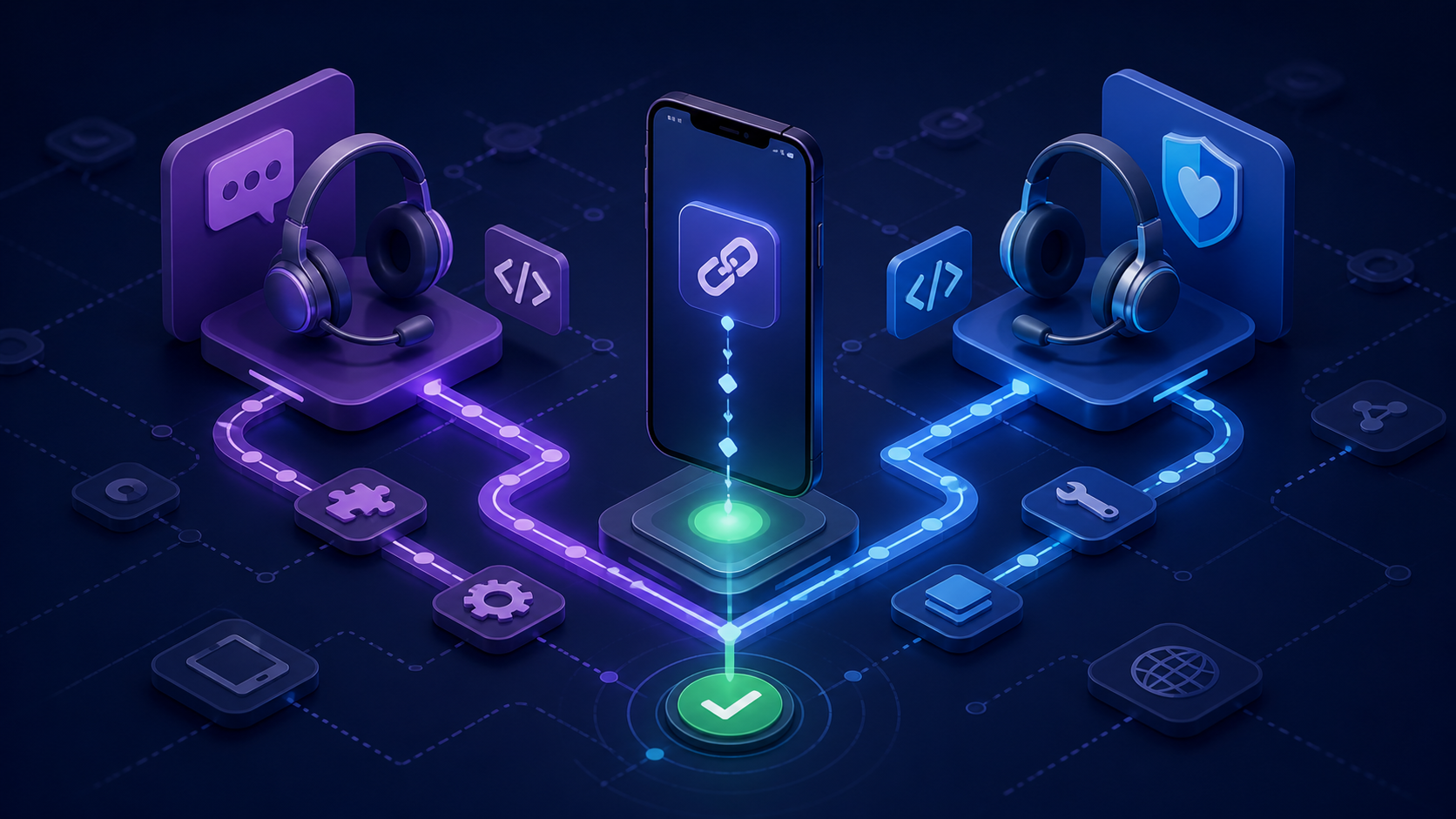
When a campaign link sends customers to a browser instead of the app, Branch support is not an abstract line item. It determines how quickly engineering can isolate a bad association file, an SDK regression, a routing rule, or a platform-specific edge case while acquisition spend is still running.
Branch and Deeplinkly both provide documentation and human support for mobile linking, but they package that help differently. Branch offers a broad enterprise support system with purchasable tiers and professional services. Deeplinkly publishes support access alongside each plan, which can make the choice simpler for lean mobile teams. The right option depends less on who promises “great support” and more on the response, escalation, and implementation model your team actually needs.
What does Branch support include?
Branch support includes a ticket portal for technical, sales, and billing inquiries, a public help center, and standard support for contracted customers. Enhanced and Premium tiers add wider availability and faster target responses; Branch currently markets Premium Support as 24/7 help with initial responses as fast as two hours.
That concise answer needs two qualifications. First, the current Branch ticket guide directs users to its support portal but does not publish response times. Second, the detailed targets live in Branch’s Service Level Addendum, last updated March 21, 2023. Your signed order form and current contract should therefore govern any purchasing decision.
The addendum describes three levels:
- Standard Support: available 9:00–17:00 in the customer’s local time on weekdays, excluding Branch holidays.
- Enhanced Support: available from Monday 00:00 through Friday 24:00 local time, excluding company holidays.
- Premium Support: available 24 hours a day, seven days a week, with written advance notice required for live troubleshooting sessions.
The same document publishes target first-response times by severity. A Branch-system outage is targeted at two hours under Standard and one hour under Enhanced or Premium. A high-severity customer outage is targeted at one business day, four hours, or two hours respectively. These are first-response targets, not guaranteed resolution times, and Branch assigns severity.
Branch also separates reactive support from implementation help. Its Professional Services program covers onboarding, custom training, advanced technical use cases, and managed services. That distinction matters: a support ticket fixes a problem, while professional services can help design or operate a complex implementation.
Branch support vs. Deeplinkly at a glance
Support comparisons often collapse documentation, ticket response, onboarding, and incident SLAs into one “support” row. They are different buying criteria. Here is the practical comparison based on public information available on August 5, 2026.
| Decision point | Branch | Deeplinkly |
|---|---|---|
| Self-service help | Extensive Account, Developer, and Marketer documentation hubs | Developer documentation for iOS, Android, React Native, Flutter, Web, REST APIs, and webhooks |
| Human support entry point | Support portal for technical, sales, and billing inquiries | Email and WhatsApp on Free; email, WhatsApp, and Slack on Pay as you go |
| Standard response model | Contracted customers receive Standard Support under the published 2023 addendum | No published response-time target; support channels are listed per plan rather than as an SLA |
| Priority support | Enhanced and Premium support are purchased through an order form | Enterprise adds priority email, WhatsApp, and Slack |
| 24/7 option | Premium Support | Not offered as a published entitlement |
| Implementation services | Formal onboarding, technical audits, integration services, and managed services | Self-serve setup plus documentation; larger migrations can be scoped with the team |
| Pricing visibility | Public page lists Basics, Essentials, and Enterprise, but not dollar prices | Per-install rates and the support channel for each plan are published before signup |
| Best fit | Large organizations with complex integrations, formal procurement, and premium escalation needs | Lean engineering and growth teams that value predictable plans and direct implementation paths |
Branch’s current pricing page lists a Basics free trial and the Essentials and Enterprise tiers. It also shows that capabilities such as unlimited partners, fraud reporting, and CTV/OTT measurement vary by tier, but it does not display dollar amounts. Ask sales to quote the product, support tier, professional services, contract term, and any response commitments separately so the comparison remains like-for-like.
Deeplinkly’s support model is simpler to reason about because there is no tier ladder to decode: Free includes email and WhatsApp, Pay as you go adds Slack, and Enterprise makes those channels priority. Deeplinkly does not publish response-time targets, so if a contractual first-response commitment is a hard requirement for your team, Branch’s addendum is the more complete document to negotiate against. If your immediate need is deep linking and attribution rather than a wide enterprise services program, review Deeplinkly’s published pricing against your monthly attributed installs before scheduling a broader vendor evaluation.
Where Branch support has the advantage
Branch is the stronger support choice when the platform sits inside a complicated enterprise growth stack and the organization wants specialized services around it.
A broad, segmented knowledge base
Branch’s Account Hub covers app and link settings, permissions, SSO, testing, data privacy, and billing, then routes readers to separate marketer and developer hubs. That structure can help a large team give administrators, marketers, and engineers role-specific material instead of forcing everyone through one implementation guide.
The tradeoff is navigation overhead. A developer debugging a failed route may cross product documentation, platform documentation, and account configuration before opening a ticket. During a proof of concept, measure “time to a verified answer,” not the number of help-center pages.
Formal premium escalation
Branch’s current Premium Support page advertises 24/7 availability, faster initial responses, scheduled Zoom calls, and a dedicated escalation resource. For a multinational app with round-the-clock campaigns, those controls may justify a paid support tier.
Confirm the details in writing. Ask which incidents qualify, who sets severity, what counts as the first response, how often updates arrive, and whether weekends apply to live troubleshooting. The 2023 addendum, for example, describes 24/7 Premium availability while excluding weekends and company holidays from live troubleshooting calls.
Hands-on services for complex launches
Branch offers onboarding, technical audits, integration services, and managed campaign operations. This is useful when many business units, domains, apps, ad partners, and approval chains must move together. A smaller team may not need that service surface; a global retailer might consider it essential risk control.
Where Deeplinkly support has the advantage
Deeplinkly is the more direct fit when the support problem is tightly coupled to implementation speed, transparent cost, and access to the same core deep-linking capabilities without a large services engagement.
Support is visible before procurement
Deeplinkly publishes the support channel for each plan before signup: email and WhatsApp on Free, email, WhatsApp, and Slack on Pay as you go, and priority access to the same three channels on Enterprise. Every product capability is on every plan — volume, retention, and support channel are what change. What Deeplinkly does not publish is a response-time target, so treat the channel as the commitment and confirm anything stricter in writing.
A smaller path from symptom to owner
For lean teams, fewer handoffs can matter more than a large support organization. A deep-link failure usually spans the link provider, app build, domain association, device state, and operating system. Direct access to a product-focused support path can keep the investigation centered on the actual implementation rather than administrative routing.
Developer-led diagnosis remains possible
Good support should make your team more capable, not make every configuration change dependent on a ticket. Deeplinkly provides platform SDK documentation and no-login tools such as a deep-link debugger and association-file generator, so engineers can validate common failure points before escalating.
That does not mean smaller always wins. Branch remains a credible choice when its wider integration and service ecosystem matches the organization. Deeplinkly is strongest when a focused mobile team wants core linking and measurement with a support level that scales predictably.
How to make any Branch support ticket resolve faster
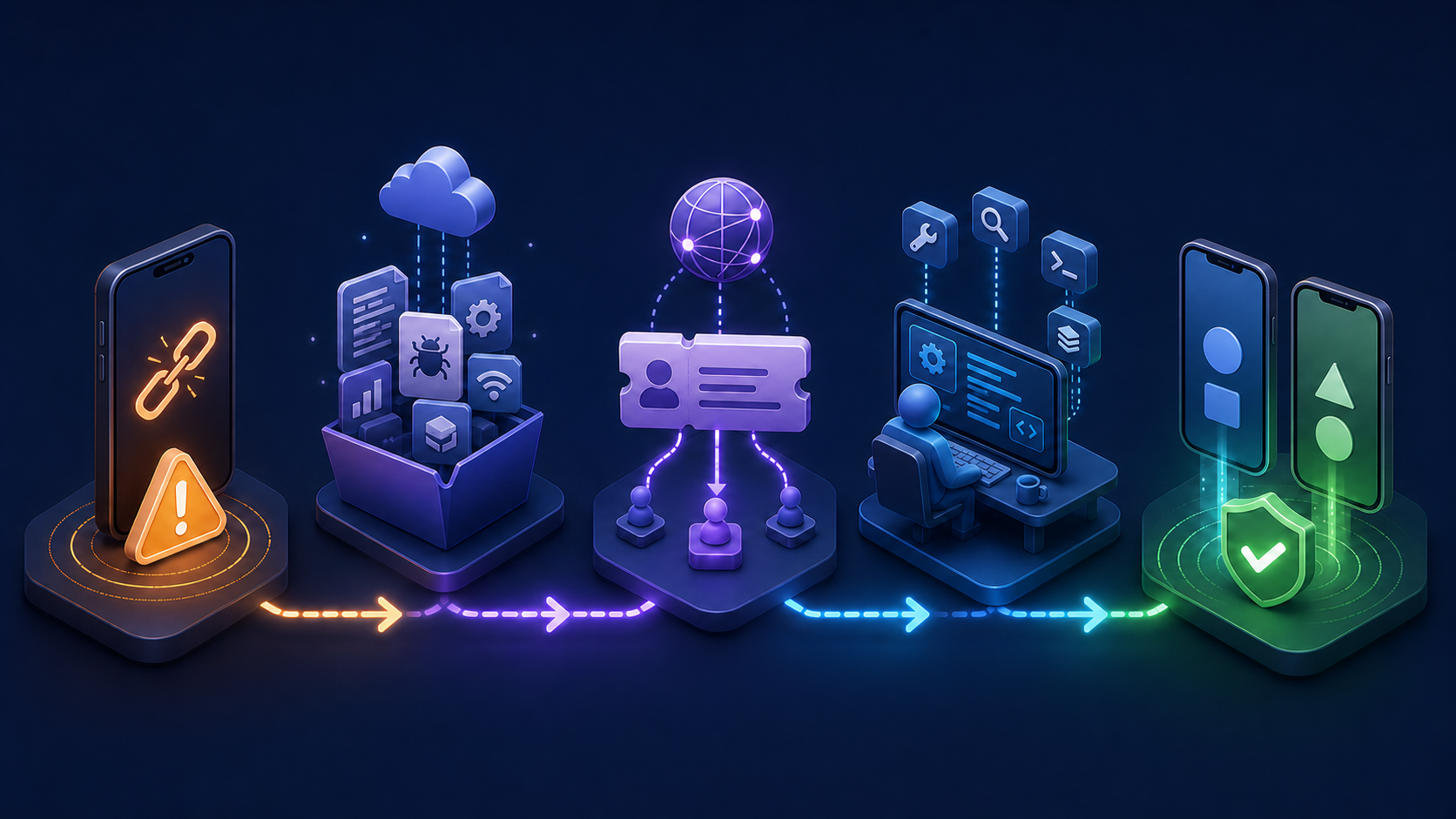
The fastest support plan cannot compensate for an incident report that says only “deep links are broken.” Linking failures are stateful: behavior changes by operating system, app version, install state, source app, browser, domain, path, consent state, and campaign parameters. Build a reproducible evidence packet before opening a ticket.
1. State the customer impact and time window
Lead with what users experience and when it began. Include affected campaigns, approximate volume, the last known good time, and whether paid traffic is still active. This helps support distinguish a production incident from a configuration question.
2. Provide one sanitized failing URL
Share an exact example while removing secrets and personal data. Include the expected destination and actual destination for installed and not-installed states. If multiple domains fail differently, provide one example per domain rather than a large unsorted list.
3. Record the test matrix
At minimum, capture:
- operating system and exact version;
- device model or emulator/simulator;
- app version and build number;
- fresh install, upgrade, or already installed state;
- source app or browser where the link was tapped;
- expected route and observed route;
- timestamp with time zone and any request or click identifier;
- screen recording plus sanitized SDK logs.
Platform evidence matters because the provider is not always the failing layer. Apple’s universal-link debugging technote explains that an AASA file must be available at the correct domain, and that same-domain browser navigation can intentionally remain in the browser. Google’s App Links verification guide shows how Android verifies assetlinks.json and how to reset and re-run domain verification on a device.
4. Verify the domain association independently
Check that the AASA and assetlinks.json files return successfully without unexpected redirects, contain the production identifiers and signing fingerprints, and match the hostname in the app. Google’s App Links troubleshooting guide highlights redirects, incorrect signatures, and intent-filter mistakes as common verification failures.
Run the operating system’s own diagnostic before attributing the failure to the vendor. On iOS, test from a tappable link rather than typing the URL into the browser address bar. On Android, capture pm get-app-links output after re-verification. Attach results as text so support can search them.
5. Separate service health from configuration
Check the vendor’s status page and preserve the timestamp. Branch’s public status page reports the API, dashboard, link redirection, deep linking, exports, and webhooks separately and offers email, SMS, webhook, Atom, and RSS notifications. A green dashboard does not prove your configuration is correct, but it narrows the investigation.
6. Ask for the next diagnostic action
End the ticket with one concrete request: confirm whether the click reached the provider, validate the link configuration, identify the rejected association, or state the next log needed. Also ask when the next update is due under your support tier. This turns a vague request for help into a bounded investigation.
How to test Branch support before you commit
Support quality is difficult to infer from a sales deck, so test the operating model during the proof of concept.
- Open a real technical question. Use a non-urgent integration edge case and measure time to a technically useful response, not merely an acknowledgement.
- Run an installed and deferred-link test. Cover iOS and Android, at least two source apps, and both fresh-install and already-installed states.
- Ask who owns cross-layer failures. Learn what happens when the root cause could be DNS, an association file, an SDK, a browser, or an ad partner.
- Exercise escalation. Ask how severity is assigned, who can escalate, and whether support follows your local time or a central region.
- Review export and exit paths. Confirm how to export links, routing rules, and attribution data if the product or support model stops fitting.
Score both vendors against the same scenario. A formal two-hour response is valuable for a revenue-critical outage; it may be unnecessary for a pre-launch app that mainly needs clear documentation. Conversely, a low monthly price is not a saving if your team needs an enterprise integration service that the plan does not include.
Frequently asked questions
How do I contact Branch support?
Use the Branch support portal linked from its Help Center. The current ticket guide offers technical support, sales, and billing inquiry types, so choose the route that matches the issue and include the affected account.
Does Branch have 24/7 support?
Yes, Branch advertises 24/7 availability with Premium Support. Its public Service Level Addendum says Premium is purchased through an order form, so verify entitlement, target response, live-call rules, and escalation terms in your current contract.
Is Branch support included for every customer?
Branch’s 2023 Service Level Addendum says all customers are entitled to Standard Support and may purchase Enhanced or Premium Support. Because the document predates the current 2026 pricing page, confirm the applicable terms in the order form before relying on them.
What should I include in a deep-link support ticket?
Include a sanitized failing URL, expected and actual behavior, operating system, device, app version, install state, source app, timestamp with time zone, campaign or click identifier, screen recording, SDK logs, and domain-association test results. One reproducible case is more useful than many incomplete examples.
Which is better: Branch support or Deeplinkly support?
Branch is better suited to organizations that need a broad enterprise platform, purchasable premium escalation, and formal professional services. Deeplinkly is better suited to lean app teams that want published pricing, support channels tied clearly to each plan, and a developer-led path to deployment and diagnosis.
Choose the support model, not the slogan
Choose Branch when complex integrations, global operations, premium escalation, and formal implementation services justify an enterprise support relationship. Choose Deeplinkly when your team wants focused deep linking and attribution, published per-install pricing, and a shorter route from implementation question to product support.
Before deciding, write down your required hours, target first response, escalation owner, migration help, and incident evidence process. Then compare the signed terms—not marketing adjectives. If a predictable, developer-first model fits your team, compare Deeplinkly with Branch and validate the workflow with a production-like link before moving traffic.