

AVOD generates revenue from users who will never pay a subscription — and for most mobile apps, that is the majority of your install base. Understanding how to implement ad-supported monetisation correctly determines whether those users contribute meaningfully to your bottom line or simply inflate your DAU numbers.
This guide covers the technical mechanics, revenue benchmarks, ad format selection, and measurement architecture you need to build a profitable AVOD strategy inside a mobile app.
---
What Is AVOD? Core Definition and How It Works
AVOD definition: free content funded by advertising
AVOD stands for Advertising Video on Demand. It is a monetisation model where users access content for free in exchange for viewing advertisements, with revenue generated through ad impressions and clicks rather than subscription fees.
In mobile apps, AVOD extends beyond traditional streaming video. The model applies to any app that delivers free access to content, gameplay, or features while monetising through ad inventory — rewarded videos, interstitials, banners, and native placements all fall under this umbrella.
The core trade is straightforward: users receive value at zero monetary cost, and developers monetise attention instead of payment intent.
How the ad delivery pipeline works end to end
When a user triggers an ad placement in your app, a real-time auction determines which ad fills that slot. Your app sends a bid request through a mediation layer to connected ad networks or a programmatic exchange. The highest bidder wins, the creative is fetched and rendered, and you receive a revenue share of the winning CPM.
The full pipeline runs in milliseconds. Latency at any stage — slow SDK initialisation, unresponsive ad networks, poor fill rates — directly reduces revenue per session.
Most developers use a mediation SDK to manage multiple demand sources simultaneously. Without mediation, you are dependent on a single network's fill rate and floor prices, which caps your eCPM ceiling considerably.
Key AVOD revenue metrics: CPM, fill rate, eCPM and ARPDAU
CPM (Cost Per Mille) is the price an advertiser pays per 1,000 ad impressions. This varies significantly by geography, ad format, and audience segment.
Fill rate is the percentage of ad requests that return a paid impression. A fill rate below 80% means your inventory is going unfilled — direct revenue loss.
eCPM (Effective CPM) normalises revenue across formats and networks, calculated as total revenue divided by total impressions multiplied by 1,000. It is the most reliable single metric for comparing ad yield across your stack.
ARPDAU (Average Revenue Per Daily Active User) measures total ad revenue divided by DAU for a given period. This is your primary LTV input metric for AVOD.
The TV segment dominated the AVOD market with 53% revenue share in 2025 (Source: SNS Insider, 2025), underscoring how much of the advertising dollar still flows toward video inventory — a signal that video ad formats inside mobile apps command the highest CPMs in your available formats.
---
AVOD vs SVOD vs Hybrid: Choosing the Right Model for Your App
SVOD vs AVOD: different LTV curves
SVOD (Subscription Video on Demand) generates revenue through a recurring fee — your LTV calculation is relatively predictable once you know churn rate and average subscription length. AVOD generates revenue proportional to engagement: more sessions, more impressions, more revenue.
The LTV curves behave differently under pressure. SVOD LTV collapses when a user churns — revenue stops immediately. AVOD LTV degrades gradually as session frequency drops, giving you a longer tail to re-engage users before they generate zero revenue. For apps with strong casual engagement loops, this makes AVOD economics more forgiving than subscription models.
SVOD also requires a larger acquisition budget to be profitable, since you need to recover the CAC against a fixed recurring fee. AVOD can reach breakeven at much lower ARPDAU thresholds, particularly in high-volume, lower-ARPU markets.
Hybrid models: letting users choose
A hybrid model — sometimes called FAST+SVOD or AVOD+SVOD depending on context — lets users self-select their monetisation tier. Free users see ads and fund the product through impressions; paying users remove ads or unlock premium content.
This model captures revenue from both user segments without forcing a binary choice. Users who are unwilling to pay a subscription still generate ARPDAU through ad exposure, while subscribers contribute higher-margin recurring revenue.
The risk is complexity: you are now managing two distinct user experiences, two onboarding flows, and two retention strategies simultaneously. For early-stage apps, this doubles your product surface area before you have validated either model.
When AVOD beats subscription
| Criteria | AVOD Advantage | SVOD Advantage |
|---|---|---|
| User willingness to pay | Low or price-sensitive markets | High intent, premium content expectation |
| Session frequency | High DAU, short sessions | Lower DAU, deep engagement sessions |
| Content depth | Broad catalogue, casual consumption | Exclusive or premium content library |
| Geographic market | Tier 2 and 3 markets (LATAM, SEA, MENA) | Tier 1 markets (US, UK, DACH, ANZ) |
| App monetisation stage | Early stage, building user base | Established brand with proven retention |
| App LTV profile | Long-tail, high-volume users | Smaller cohort, high-value subscribers |
AVOD consistently outperforms subscription when your install-to-paying conversion rate is below 3-5%. At that conversion rate, the non-paying majority generates nothing under a pure subscription model. Under AVOD, every active user is a revenue event.
---
AVOD Revenue Models Inside Mobile Apps: Beyond Streaming Video
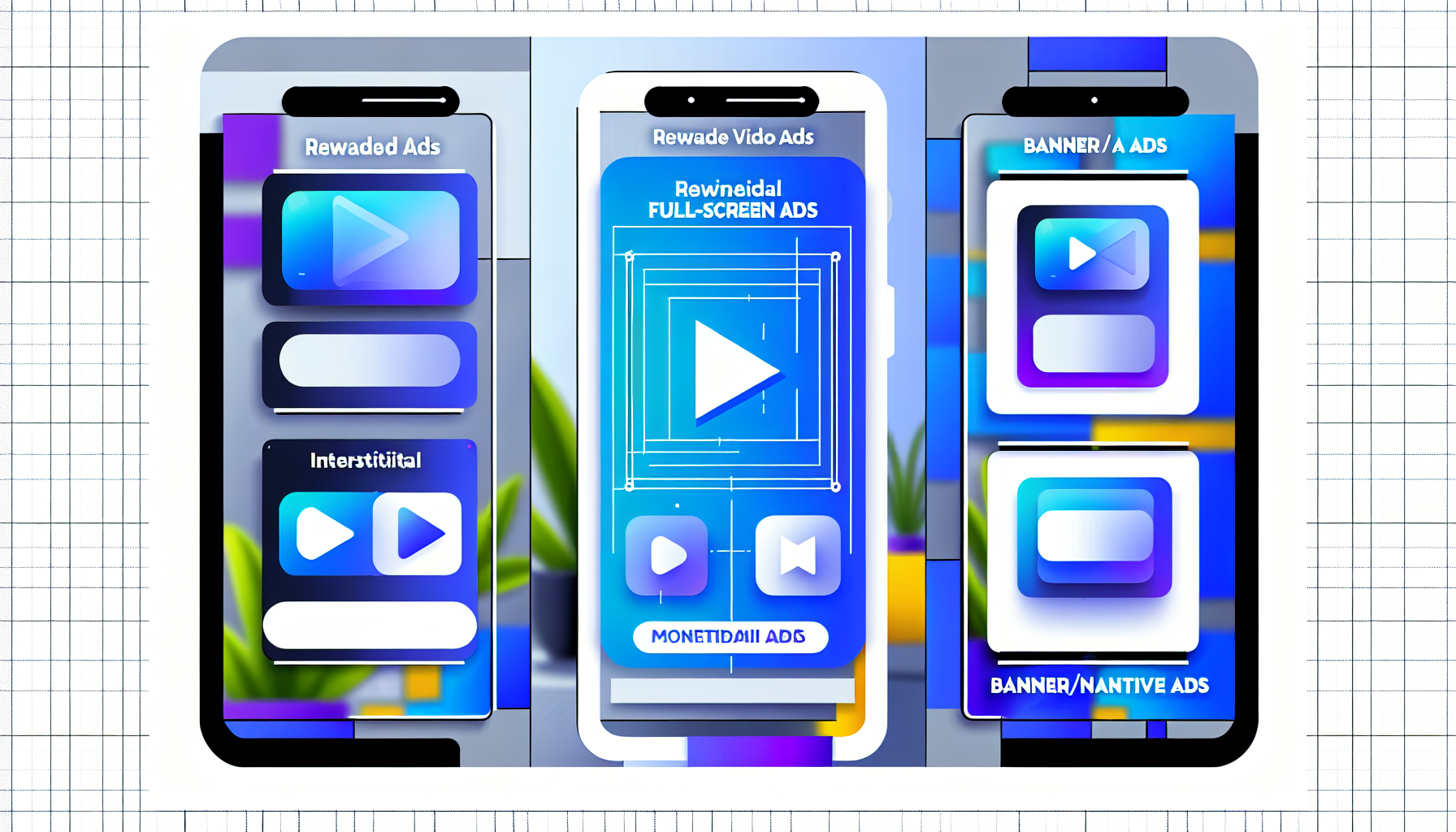
Rewarded video ads
Rewarded video is the highest-performing ad format in mobile by eCPM. Users opt in to watch a 15-30 second video in exchange for an in-app reward — an extra life, premium currency, a content unlock, or a power-up. Completion rates routinely exceed 85% because the user initiated the interaction.
eCPMs for rewarded video in Tier 1 markets typically range from $8 to $25 USD, significantly above banner or interstitial formats. For game developers, this is the primary AVOD format and often accounts for 60-70% of total ad revenue despite being a smaller percentage of total impressions.
The opt-in mechanic also reduces negative sentiment. Users who choose to watch an ad do not associate the interruption with your app — they associate it with receiving a reward.
Interstitial ads
Interstitials are full-screen ads that appear at natural transition points — between game levels, at content load screens, or after completing a session flow. They are not opted into by the user but are less intrusive than mid-content interruptions when placed correctly.
eCPMs for interstitials in Tier 1 markets range from $4 to $12 USD. Video interstitials command higher rates than static display. The critical implementation variable is placement timing: interstitials shown at logical break points have significantly lower impact on retention than those inserted arbitrarily during sessions.
Frequency capping is mandatory. Showing more than one interstitial per 3-minute session window is a measurable churn accelerant in most app categories.
Banner and native ad units
Banner ads deliver lower eCPMs — typically $0.50 to $2.00 in Tier 1 markets — but contribute to revenue through sheer impression volume across long sessions. They are persistent, require no user interaction, and add minimal implementation complexity.
Native ad units match the visual design of your app content, producing higher engagement rates than standard banners. For content apps or social feeds, native placements often outperform banners by 2-4x on eCPM due to higher viewability scores and click-through rates.
For most apps, banners and native units should be supplementary — not the primary AVOD revenue driver. They fill inventory between higher-value rewarded and interstitial placements.
Opt-in vs forced ad exposure
Opt-in ad formats (rewarded video) consistently show better retention outcomes than forced exposure formats. The trade-off is impression volume: forced formats generate more impressions per session, while opt-in formats generate higher CPMs per impression.
Apps heavily dependent on app in-app monetisation through a combination of advertising and in-game purchasing should default to opt-in formats for their primary ad revenue and use interstitials selectively at tested intervals. Forced ad exposure with no user agency correlates with higher D7 churn rates, which compresses your AVOD LTV window significantly.
---
AVOD vs In-App Purchase Economics: Which Maximises LTV?
Revenue per user: AVOD vs IAP benchmarks
The average mobile game generates between $0.02 and $0.05 ARPDAU from advertising alone in Tier 1 markets. Top-performing AVOD-heavy titles with high DAU reach $0.08-$0.15 ARPDAU through optimised mediation stacks and high rewarded video adoption rates.
In-game purchase revenue tells a different story in terms of per-user ceiling. The average payer in a mobile game spends $20-$50 per month, but paying users typically represent 1-5% of the active user base. Non-paying users — the overwhelming majority — generate zero IAP revenue.
The comparison is not straightforward. IAP delivers high revenue per payer, but AVOD monetises the entire user base. For a 100,000 DAU app with 2% payer conversion at $30 ARPU/month, IAP generates approximately $60,000 monthly. The same app at $0.05 ARPDAU generates $150,000 monthly from the same user base through AVOD. The model that wins depends entirely on your payer conversion rate and ad eCPM.
Churn dynamics: ads vs paywalls
Paywalls create a binary churn event. A user who hits a paywall and declines to pay either churns immediately or continues at a diminished engagement level that produces no revenue. The moment a user decides not to subscribe or make an in-game purchase, their revenue contribution drops to zero under a pure IAP model.
AVOD monetises through continued engagement, which means gradual churn is less economically catastrophic. A user who reduces session frequency from daily to weekly still generates impressions — just fewer. This creates a longer revenue tail for re-engagement campaigns to operate against.
The exception is ad fatigue-driven churn. Poorly configured AVOD — too many interstitials, intrusive placements, low-quality creatives — can produce churn rates equivalent to or worse than a hard paywall. The difference is that ad fatigue churn is preventable through UX configuration in a way that paywall rejection is not.
Hybrid stacking: AVOD + IAP together
The highest LTV mobile apps do not choose between AVOD and in-game purchasing — they stack both. Free users generate ARPDAU through ad impressions; paying users either remove ads or access exclusive content that non-payers cannot reach through ads alone.
AVOD acts as a monetisation floor. Every user generates some revenue regardless of payment intent. IAP acts as a monetisation ceiling — users with high willingness to pay contribute multiples above the ARPDAU baseline.
As Tinuiti observes, AVOD is a monetisation strategy where streaming platforms offer free content in exchange for watching ads (Source: Tinuiti) — and mobile apps have adapted this same exchange at the session level. The insight for developers is that "free content" includes gameplay, features, and tools, not just video content. Any app value that can be gated or rewarded becomes an AVOD monetisation surface.
---
Technical Architecture: Integrating AVOD Into Your Mobile App
Choosing a mediation SDK
Mediation SDKs are the infrastructure layer that connects your app to multiple ad networks simultaneously and runs real-time auctions to maximise eCPM. The most widely deployed options are Google Ad Manager (GAM), MAX by AppLovin, and ironSource (now Unity LevelPlay).
Your choice of mediation SDK determines which demand sources you can access, what bidding mechanisms are available, and how much engineering overhead you carry. GAM is the default for apps already in the Google ecosystem. MAX and LevelPlay tend to outperform on eCPM for gaming apps due to their demand network depth in that category.
Evaluate mediation SDKs on four criteria: available demand sources, in-app bidding support, SDK size impact on your app binary, and quality of reporting APIs. SDK bloat is a real consideration — adding 5-10MB to your app binary affects install conversion rates in markets with storage-constrained devices.
Ad network waterfall vs programmatic bidding
The traditional waterfall model sets a priority order for ad networks — if Network A does not fill at your floor price, the request waterfalls to Network B, then C. This is predictable but slow and structurally favours whichever network you put at the top of the waterfall.
In-app bidding (also called header bidding or simultaneous auction) sends the bid request to all networks simultaneously and awards the impression to the highest real-time bid. This consistently outperforms waterfall configurations by 10-30% on eCPM because it creates genuine competition for every impression.
If your mediation SDK supports in-app bidding — and all major ones now do — there is no good reason to remain on a pure waterfall configuration. Migrate to bidding for rewarded video and interstitials first, then extend to other formats.
iOS ATT and Android Privacy Sandbox impact
Apple's App Tracking Transparency (ATT) framework requires explicit user opt-in before your app can access the IDFA for ad targeting. In markets where opt-in rates are low (typically 30-45% in most app categories), a significant proportion of your ad inventory is served without user-level targeting data.
Untargeted inventory commands lower CPMs — typically 30-50% lower than targeted impressions. This makes ATT opt-in rate a direct AVOD revenue variable. Contextual opt-in prompts — shown at moments when the user has received clear value from the app — consistently outperform generic permission dialogs.
Android's Privacy Sandbox is introducing similar constraints through the deprecation of the Advertising ID in favour of the Privacy Sandbox APIs (Topics API, Protected Audience). The implementation timeline and industry adoption remain in flux, but the directional shift is clear: user-level targeting without consent is being structurally removed from both platforms.
Implementation checklist
Before going live with your AVOD stack, verify each item:
- Mediation SDK integrated and tested in staging environment
- At least three ad networks connected with floor prices set per format and geography
- In-app bidding enabled for rewarded and interstitial placements
- Frequency caps configured (maximum 1 interstitial per 3-minute window as a starting point)
- ATT prompt implemented on iOS with contextual placement tested
- Ad quality controls enabled to block low-quality or inappropriate creative categories
- Revenue reporting pipeline connected to your analytics stack
- ARPDAU tracked as a primary daily KPI
Deeplinkly connects your AVOD ad attribution directly to deep linking and user journey data in under 30 minutes. It is a privacy-first alternative to AppsFlyer and Branch that lets you measure exactly which ad format drives the highest LTV cohorts without overpaying for your MMP.
---
Measuring AVOD Performance: Attribution, Cohorts and Revenue Signals
ARPDAU and eCPM tracking
ARPDAU is your headline AVOD performance metric, but it aggregates across formats, geographies, and user segments in ways that can obscure actionable signals. Break it down by format (rewarded vs interstitial vs banner), by geography (Tier 1 vs Tier 2 markets), and by user cohort (day of install, acquisition channel, device type).
eCPM fluctuates by day of week, seasonality, and ad market demand. Q4 consistently produces the highest eCPMs of the year due to holiday advertiser spend — eCPMs in November and December can be 30-60% higher than Q1 in the same geography. Normalise your benchmarks across these cycles before concluding your ad stack is underperforming.
Track fill rate daily. A sudden fill rate drop below 70% indicates either an ad network configuration issue or a floor price set above market clearing price. Either requires immediate action — unfilled inventory is permanent revenue loss.
Cohort analysis by acquisition channel
Not all users generate the same ARPDAU. Users acquired through paid social channels often have different session patterns than organic users or users from connected TV (CTV) campaigns. Understanding CTV meaning in the context of your acquisition mix matters here: CTV campaigns drive app installs from TV-delivered ads, and these cohorts often show different in-app engagement profiles than mobile-native acquisition channels.
Segment your ARPDAU by acquisition source to identify which channels produce the highest ad revenue LTV. A user cohort that costs $1.50 CPI but generates $0.06 ARPDAU has a different payback period than one that costs $0.80 CPI but generates $0.03 ARPDAU — and the former is the better investment despite higher upfront cost.
Cohort analysis also reveals the interaction between AVOD and IAP. Users who engage with rewarded ads early in their lifecycle often show higher IAP conversion rates — the opt-in behaviour signals engagement depth that correlates with payment intent.
Common measurement mistakes
AVOD advertisers face a fragmented marketplace, measurement challenges, and difficulty targeting specific users (Source: Penthera) — and the same fragmentation problem affects measurement on the supply side. Developers frequently make three measurement errors that distort their AVOD performance picture.
First, they report on aggregate ARPDAU without segmenting by ad-engaged vs non-ad-engaged users. These two populations have fundamentally different retention curves and cannot be optimised using the same levers.
Second, they attribute revenue to the ad network that delivered the impression rather than the acquisition channel that brought the user. This breaks the CAC-to-LTV equation and makes media buying decisions based on incomplete data.
Third, they fail to account for ad impression timing in session analysis. Revenue generated in the first 60 seconds of a session behaves differently from revenue generated after 10 minutes — and optimising placement timing requires tracking both.
---
UX and Retention Strategy for AVOD Apps
Ad frequency and session design
Ad frequency is the single most controllable retention variable in your AVOD stack. Every additional interstitial above your optimal frequency increases short-term revenue and increases churn probability simultaneously — the question is where the crossover point is for your specific app.
Run controlled frequency experiments with distinct user cohorts. Test one interstitial per level vs one per three levels, measure D1, D7, and D30 retention alongside ARPDAU for each cohort, and find the frequency that maximises cumulative 30-day revenue per install — not daily revenue per session.
Design your session flow to place ad moments at natural completion points. A rewarded video offered after a user completes a level or finishes a content piece generates less friction than the same ad interrupting active engagement.
Rewarded ads as a retention lever
Rewarded ads do something that most ad formats cannot: they increase session time. Users who engage with rewarded video placements extend their sessions to consume the reward, which increases overall engagement depth and correlates with better D7 and D30 retention.
Position rewarded ads as part of your progression system rather than as monetisation prompts. "Watch a video to continue" framing converts more users than "Watch an ad" — even when the underlying action is identical. The perceived value of the reward drives completion intent more than the format of the ask.
For game developers, rewarded ads placed at natural difficulty spikes — moments where users are most likely to churn due to frustration — convert at significantly higher rates and actively reduce churn at that specific funnel stage.
When to offer ad-free upgrade
An ad-free subscription tier makes sense when your user research shows a meaningful segment willing to pay to remove ads but unwilling to pay for content alone. This is a distinct buyer psychology from subscription-for-content and requires different pricing and positioning.
Price the ad-free tier below your full subscription if you offer one. The ad-free user is telling you their primary objection is the ad experience, not that they value premium content — they just want your app without interruptions. Matching that value proposition with pricing converts better than bundling features they did not ask for.
Test ad-free upgrade prompts after your highest-friction ad moments — immediately after a skipped interstitial or following a rewarded ad that generated a negative sentiment signal (low session time following ad completion).
---
Frequently Asked Questions
What does AVOD mean?
AVOD stands for Advertising Video on Demand. It refers to a content delivery and monetisation model where users access video content or app features for free, with revenue generated through advertising rather than subscription fees or one-time purchases. In mobile apps, AVOD encompasses any ad-supported free-access model including rewarded video, interstitials, and banner placements.
What is the difference between SVOD and AVOD?
SVOD (Subscription Video on Demand) requires users to pay a recurring fee to access content, while AVOD provides free access funded by advertising revenue. SVOD generates predictable recurring revenue from paying subscribers but excludes non-paying users entirely. AVOD monetises all active users through ad impressions but generates lower revenue per user than a subscriber paying a monthly fee. Many apps run hybrid models combining both.
Is Netflix an AVOD?
Netflix is primarily an SVOD platform, but it launched an ad-supported tier in November 2022 that operates as AVOD. Users on the ad-supported plan pay a lower monthly fee and view advertisements during content. Netflix's core offering remains subscription-based, making it a hybrid SVOD/AVOD platform rather than a pure AVOD service.
Is YouTube considered AVOD?
Yes, YouTube is considered an AVOD platform. YouTube provides free access to video content funded by advertising revenue, which is the defining characteristic of the AVOD model. Users who do not subscribe to YouTube Premium watch ads before and during videos, and creators earn revenue through those ad impressions. YouTube Premium converts the experience to an ad-free subscription model, making YouTube itself a hybrid AVOD/SVOD platform at the product level.
---
Conclusion: Choosing Your Monetisation Stack
The right monetisation model depends on where your app is and who your users are. At early stage with an unproven user base, AVOD reduces the barrier to building a large active cohort while generating revenue from day one. As you identify high-intent users, layering in IAP or an ad-free subscription tier increases revenue ceiling without sacrificing the AVOD floor.
Pure IAP or subscription models work when conversion rates justify the non-paying majority generating nothing. For most mobile apps, that condition is not met — and AVOD economics become the smarter foundation.
If you are at the stage of measuring which combination of ad formats and acquisition channels drives the best 30-day LTV, explore our related guides on app attribution and deep linking strategy for mobile growth teams.
Measure which channels drive your best AVOD cohorts
Deeplinkly attribution connects UA spend to real ad revenue LTV — so you know which acquisition channels bring users who watch ads and stick around. Free to start, 30-minute integration. Start free or talk to sales.